RSN Fundraising Banner
FB Share
Email This Page
add comment
Politics
The Culture of Male Silence: Men Treat Sexual Assault Like America Treats White Supremacy Print
Written by <a href="index.php?option=com_comprofiler&task=userProfile&user=44501"><span class="small">Michael Harriot, The Root</span></a>   
Thursday, 02 November 2017 08:38

Harriot writes: "I don't like groupthink, millennially correct phrases like 'safe spaces' and 'microaggressions,' and so I don't use the term 'rape culture.' But I realize we live in a society that doesn't just perpetuate sexism but promotes sexual assault with a culture of silence. And just as with racism, that willingness to turn our heads and not condemn sexual assault is an implicit signal that it is OK."

A failure to condemn sexual assault or racism is an implicit signal that it is OK. (photo: iStock)


The Culture of Male Silence: Men Treat Sexual Assault Like America Treats White Supremacy

By Michael Harriot, The Root

02 November 17


am not a religious man by any measure, but there are universal truths to which I adhere. I believe that love is a byproduct of love. I believe that hate made love to an orange, had a petty-ass baby, and that’s how we got the grapefruit. I believe that cats were put on earth to kill things. And I believe the universe recycles.

Reincarnation is real. When we stop breathing, our bodies will all eventually turn into the fuel for flowers and trees. Those trees will, in turn, take the fuel of our decomposed former selves and convert carbon dioxide into oxygen that a newborn baby will one day inhale for the first time. We are all dying. To die is to give life.

And if my body becomes a tiny point in the circle of life, it only makes sense that my soul will also be reincarnated. I have no idea how the universe may use my factory-refurbished soul. I’m cool with becoming a yak or a large-mouthed bass in the next life. (Fair warning to the universe: I am a terrible swimmer.) There is only one thing I pray I will never be:

The white man.

Not a white man, but the white man. The perpetual oppressor of people. The kicker of teeth. He who places boot on neck. I pray to the man upstairs (I’m getting my roof fixed right now) that when my soul is washed, dried and placed in the “barely used” bin of the universal thrift shop, I am not remade into the white man.

I often fling disdain at people who unknowingly participate in white-man-ery. I believe that any white person not actively fighting to end every form of racism and oppression is an accomplice. I fault white people who sit silently while their fellow Caucasians say or do something racist when no one black is around. I consider them to be upholders of white supremacy as much as the cross burners or swastika wearers. They are “the white man,” too.

But I realize I am a living, breathing double standard. I have not held myself accountable in the same way in which I hold white people’s feet to the fire on the issue of race.

I don’t like groupthink, millennially correct phrases like “safe spaces” and “microaggressions,” and so I don’t use the term “rape culture.” But I realize we live in a society that doesn’t just perpetuate sexism but promotes sexual assault with a culture of silence. And just as with racism, that willingness to turn our heads and not condemn sexual assault is an implicit signal that it is OK.

One night while I was having a few drinks with friends, a guy recognized someone at my table and came over to say hi. At some point during his conversation, the waitress came over, and out of nowhere, he asked this teenage-looking girl: “Can you make it clap?”

Everyone knew it was kind of creepy, but I said, “Hey, man, what the fuck is wrong with you? That girl is, like, 16.” He tried to laugh it off by joking: “You know what Keith Sweat said: She may be young, but ... ”

By then the rest of the people at the table agreed that he was being a little bit rapey.

A few months later, I was with the same friends at the same watering hole (what, motherfucker? It’s not like I live in Paris. I’m in Birmingham!), and they began telling me about a high school teacher who had been arrested on charges that he slept with multiple students. Because I’m not originally from this town (and apparently only go to one place to have drinks), I assumed that I didn’t know who they were talking about.

It was the same rapey table crasher.

Here’s my point. I’m not insinuating that every guy who makes suggestive comments to a Buffalo Wild Wings waitress is a potential sexual assaulter. But I wonder how often we perpetuate the ideology of the disposability of women’s bodies by just not saying shit.

If we are honest, every single man has known a guy who was a habitual line stepper when it came to women or who was a little bit rapey. The frat brother who will grab a random woman’s booty. The boss who has tried to fuck everyone in the office. The football teammate who always talks about “running a train.” I also believe every single white person has a parent, co-worker or cousin (wait ... do white people have cousins?) who leans a “little bit racist.”

But just like there is no such thing as being a little bit racist, there is no such thing as being “a little bit rapey.”

Why are we cool with one and not the other?

If we refused to remain quiet about the dudes who do this shit, I’m not saying that it would end sexual assault, but it might curtail the actions of the men whose actions are fueled by the complicity of silence.

Everyone knew about Harvey Weinstein and didn’t say shit. Bill Cosby’s predilection for slipping Mickeys was an open secret for decades. Do you think R. Kelly’s friends are just now noticing that some of the girls surrounding him are a little short in the tooth?

I know some woke-ass dudes who would open-hand smack a Caucasian’s face off if the white person uttered the word “nigger” in their presence, even if that person wasn’t using the n-word in reference to anyone in particular. It wouldn’t matter if the recipient of the smack were singing along to a Tupac song or used the version of the word with the “a” at the end—he or she would become an unwilling participant in the catching of hands.

But those same woke-ass dudes wouldn’t say a damn word if a guy talked about “taking some pussy” or brought up booty-clapping to a teenager trying to do her job.

We ain’t shit.

And I know some dude out there will argue that not every black man is complicit in sexual assault. To those people, I will give the same reply I give when a teary-eyed Chad or Becky approaches me with the preamble to all race-related Caucasian conversations: “Not all white people ... ”

And here’s my well-thought-out, nuanced response for those brethren:

Then, nigga, I wasn’t talking about you!

I don’t think I ask white people to do something that I am not willing to do myself as a black man. That includes holding myself and the people around me accountable for the things I say I stand for. The things that are right.

It might seem self-righteous and preachy, but I’m talking about me. I’m talking about us. I want us to do better. I want to be better.

But, most of all, I don’t want to be anyone’s white man.


e-max.it: your social media marketing partner
 
Trump Accuses Clinton of Deliberately Losing Election so He Could Be Impeached Print
Written by <a href="index.php?option=com_comprofiler&task=userProfile&user=9160"><span class="small">Andy Borowitz, The New Yorker</span></a>   
Wednesday, 01 November 2017 14:46

Borowitz writes: "In what might be his most startling allegation against his former election opponent, Donald Trump on Wednesday accused Hillary Clinton of deliberately losing the 2016 election just so that he could be impeached."

Donald Trump and Hillary Clinton at Presidential Debate. (photo: Doug Mills/NYT)


Trump Accuses Clinton of Deliberately Losing Election so He Could Be Impeached

By Andy Borowitz, The New Yorker

01 November 17


The article below is satire. Andy Borowitz is an American comedian and New York Times-bestselling author who satirizes the news for his column, "The Borowitz Report."


n what might be his most startling allegation against his former election opponent, Donald Trump on Wednesday accused Hillary Clinton of deliberately losing the 2016 election just so that he could be impeached.

“How could one of the most experienced politicians in history lose to the most unfit candidate ever?” Trump asked reporters. “Crooked Hillary lost on purpose because she wanted me to be impeached.”

Explaining Clinton’s motives for intentionally sabotaging her quest for an office she had coveted for decades, Trump said, “Hillary Clinton is more than a nasty woman. She is an evil woman, and her sick mind is capable of anything.”

Trump said that instead of reporting the “fake story” of his campaign’s collusion with the Russians, the media should focus on Clinton’s “diabolical scheme to lose the election.”

“I don’t know if Hillary Clinton lost the election on her own,” Trump said. “Maybe she asked the Russians to help her lose. But the fact is, Hillary Clinton deliberately plotted to put me in the White House, and the American people should be very angry about that.”


e-max.it: your social media marketing partner
 
The ACA Open-Enrollment Period, Which Starts Today, Is a Little Different Under Trump Print
Wednesday, 01 November 2017 14:43

Benen writes: "As of this morning, American consumers can sign up to have health care coverage in 2018. The healthcare.gov website is up and running, and though Donald Trump has pushed prices higher, many consumers will find that insurance costs in this open-enrollment period are very affordable."

ACA Open-Enrollment Period starts November 1. (photo: Reuters)


The ACA Open-Enrollment Period, Which Starts Today, Is a Little Different Under Trump

By Steve Benen, MSNBC

01 November 17


s of this morning, American consumers can sign up to have health care coverage in 2018. The healthcare.gov website is up and running, and though Donald Trump has pushed prices higher, many consumers will find that insurance costs in this open-enrollment period are very affordable.

That said, as TPM noted, many in the industry have low expectations for the first enrollment period of the Trump era.

On the eve of the first full open enrollment period of the Trump era, several independent studies estimate that enrollment will drop this year as a result of the administration’s actions to gut outreach funding, cancel planned subsidy payments to insurers, and sow confusion with public statements declaring the Affordable Care Act “dead.”

S&P Global Ratings published a report Tuesday projecting that enrollment will drop between 7 and 13 percent compared to last year – meaning between 0.8 and 1.6 million more people will go uninsured in 2018.

It’s important to realize that this isn’t an accident or a symptom of systemic troubles. It’s the result of deliberate policy decisions made by Republican officials who don’t want the existing American system to succeed.

There are quite a few veterans of the previous administration, however, who intend to do what the current administration won’t: encourage people to sign up for health care coverage.

Barack Obama is already using his social-media platform to promote the open-enrollment period – the former president even recorded a brief new video – and as NBC News recently reported, some members of his former team are eager to help in the same endeavor.

As evidence mounts that the Trump administration is undermining next month’s Obamacare enrollment period, veterans of the previous administration are planning a parallel effort to sign people up for health insurance.

The new group, Get America Covered, is led by Lori Lodes and Josh Peck, who both worked on enrollment efforts under Obama. Other participants include Van Jones, former acting administrator of the Centers for Medicare & Medicaid Services, Andy Slavitt, former insurance CEO Mario Molina, and actors Bradley Whitford and Alyssa Milano.

If you’re waiting for Trump to do his part to help, stop. He’s already taken steps to sabotage the Affordable Care Act, and his attacks against the law have created widespread confusion among consumers, which is likely to contribute to decreased participation.

I’m curious, though, about whether health care advocates could’ve tried a different rhetorical strategy with this White House. I’ve long wondered how Trump would’ve responded if this were presented to him as a dare.

What if Democratic leaders publicly predicted, “I bet Trump’s enrollment totals fall far short of Obama’s”? What if the question Trump wanted to avoid early next year was, “Why were Obama’s numbers so much better than yours?”

Because once the open-enrollment period ends, there are going to be some head-to-head comparisons, and the Republican White House is going to have to explain why Trump’s totals look awful compared to Obama’s.


e-max.it: your social media marketing partner
 
Why a Judge Ruled Paul Manafort Isn't Entitled to Attorney-Client Privilege Print
Wednesday, 01 November 2017 14:39

Excerpt: "When you meet with your lawyer, you can tell her the whole ugly story because she can't be forced to testify against you or even to divulge what you've discussed to anyone. Period. Right? Well ... mostly right."

Former Trump campaign manager Paul Manafort hides behind his car visor as he leaves his home in Alexandria, Virginia, on Monday. (photo: Reuters)


Why a Judge Ruled Paul Manafort Isn't Entitled to Attorney-Client Privilege

By Dahlia Lithwick and Scott Pilutik, Slate

01 November 17


t’s not an overstatement to characterize the attorney-client privilege as the cornerstone of criminal law, an inviolable right that can and must withstand all manner of legal aggression.* It’s also one of the small handful of criminal procedural notions sewn directly into our pop culture fabric. Even if all your legal knowledge comes from watching Law & Order, you’re still likely aware of your Miranda rights; that law enforcement needs probable cause to search your apartment and maybe (but maybe not) your car; and most especially that when you meet with your lawyer, you can tell her the whole ugly story because she can’t be forced to testify against you or even to divulge what you’ve discussed to anyone. Period. Right?

Well … mostly right. On Monday, Politico reported that Chief Judge Beryl A. Howell of the U.S. District Court for the District of Columbia had agreed to allow Robert Mueller to use something called the crime-fraud exception to attorney-client privilege to compel testimony from an attorney who formerly represented Paul Manafort and Manafort’s onetime employee Rick Gates. Although that development got lost in the blizzard of Robert Mueller news, Howell’s willingness to pierce attorney-client privilege, as well as her frank description of falsehoods as falsehoods, was in some sense the big news of the day. It was an astonishing win for the special counsel, one that reveals both Mueller’s willingness to use tough tactics and the ways in which the judicial branch may be willing to treat the cover-ups that emerge from the Trump probe. In a way, the decision revealed that the courts may be as tired of houses built of deception as the rest of us are.

Other than relatively common third-party waivers (which happen when the attorney-client communication occurs outside that protective bubble), exceptions to the sacred attorney-client privilege are incredibly rare. The crime-fraud exception is perhaps the rarest exception of them all. These cases are so infrequent precisely because they require uniquely awful behavior by the client and even sometimes by the client’s attorney. Rule of thumb? Behind any successful crime-fraud exception application there is almost certainly one hell of a story.

In a 37-page opinion dated Oct. 2 and unsealed this week, Judge Howell determined that Manafort and Gates’ former attorney could be compelled by Mueller “to testify before a grand jury regarding limited aspects of her legal representation of the Targets, which testimony the [special counsel’s office] believes will reveal whether the Targets intentionally misled [the Department of Justice] about their work on behalf of a foreign government and foreign officials.”

The crime-fraud exception holds that if a client seeks legal advice in furtherance of a crime, privileged communications between the attorney and client are waived. In effect, the distinction is as follows: You can safely tell your lawyer where you buried the bodies, but you can’t ask your lawyer how to bury the bodies.

The indictment against Manafort and Gates is a veritable laundry list, 12 counts in all, but the charges can be summarized as conspiracy to launder money, failure to disclose foreign bank accounts, failure to register as agents of a foreign principal, and making false and misleading statements to the Foreign Agents Registration Unit. The special counsel’s office alleges that Manafort collected millions of dollars for work he did on behalf of the Ukrainian government between 2007 and 2012 yet declined to report that work to FARA and failed to inform the Internal Revenue Service about the income he earned from this activity.

Fast-forward to late March 2016, when Manafort became Donald Trump’s campaign manager. That lasted until Manafort’s Russian connections—specifically the August 2016 discovery of handwritten ledgers showing $12.7 million in undisclosed cash payments to Manafort—suddenly become a problem for Trump. The then–Republican nominee accepted Manafort’s resignation on Aug. 19, 2016.

A short time later, Trump won the presidential election, an event that surprised many, including perhaps even Trump himself. Consequently, key figures in the Trump campaign began to receive a level of scrutiny they likely hadn’t anticipated. A short time after the election, Manafort and Gates responded to FARA’s request for an explanation of their activities. No doubt aware of their quandary—they should’ve registered but didn’t—Manafort and Gates sought legal help, and so it was their attorney who responded to FARA three times: on Nov. 23, 2016; Feb. 20, 2017; and June 27, 2017.

The problem here was that some of these letters made assertions that turned out to be, from the vantage of the special counsel’s office and then the judge, quite false. As Judge Howell characterized it, the “2017 FARA Submission attempts to paint the Targets as mere spectators in a game when they actually were integral players.” Judge Howell notes that the special counsel’s office wasn’t seeking confidential notes or discussions between counsel and her clients. Mueller and his team merely wanted to confirm facts she had passed along as having originated with Manafort and Gates. To put it another way, Mueller is asking the judge to get him answers to simple questions about whether Manafort and Gates lied to counsel and whether counsel in turn passed those lies along.

In her opinion, Judge Howell says she’s well aware of the centrality of the attorney-client privilege. “The attorney-client and work-product privileges play vital roles in the American legal system, by encouraging persons to consult freely and candidly with counsel, and counsel to advocate vigorously on their clients’ behalves, without fear that doing so may expose a client to embarrassment or further legal jeopardy,” she writes. She pits that privilege, though, against the need to have grand juries do their work, noting that they are “an essential bedrock of democracy, ensuring the peoples’ direct and active participation in determining who must stand trial for criminal offenses.”

The nature of counts 11 and 12 of the indictment—lying, falsifying, and misleading the government—went a long way toward dictating the availability of the crime-fraud exception, which requires a showing that the engagement of legal advice was to further a “criminal or fraudulent scheme.” The evidence suggests Manafort and Gates planned to lie and decided that having a lawyer do that lying for them might help shield them from prosecution. But in so doing they made it easy for Judge Howell to find the requisite nexus between the crime—the lies—and the crime-fraud exception. In addition to allegedly laundering money through Cyprus corporations and Hamptons landscapers, Manafort is effectively being called out for laundering his alleged lies through his attorney. (It’s worth noting that it’s not Manafort and Gates’ attorney who is on the hot seat here. That’s largely because the crime-fraud exception applies when the crime in question involves lying to the government and your attorney is merely a conduit for those lies.)

Assuming the indictment’s accuracy, Manafort has been a modern-day version of Henry Hill in Goodfellas: accepting millions of dollars from dictators, funneling that cash through dozens of foreign corporations, and buying up the good life here in the states (one can never have too many $1,000 neckties). High risk, high reward, and … wait, is that helicopter following me? It shouldn’t surprise anyone, then, to see Manafort allegedly playing fast and loose with his own lawyers. Like his former boss, Manafort seems to hold the view that attorneys are hired help, good for emptying ashtrays and passing along lies.


e-max.it: your social media marketing partner
 
NSA Wanted to Use the Espionage Act to Prosecute a Journalist for Using FOIA Print
Wednesday, 01 November 2017 14:30

Best writes: "Declassified documents in the Central Intelligence Agency's archives show that while the CIA was looking to include the Freedom Of Information Act in its war on leaks, the National Security Agency was seriously considering using the Espionage Act to target target Puzzle Palace author James Bamford for using FOIA."

James Bamford, an expert on the National Security Agency, was targeted by the NSA in a potential Espionage Act prosecution for using FOIA. (photo: Brendan Smialowski/The New York Times)


NSA Wanted to Use the Espionage Act to Prosecute a Journalist for Using FOIA

By Emma Best, MuckRock

01 November 17


eclassified documents in the Central Intelligence Agency’s archives show that while the CIA was looking to include the Freedom Of Information Act in its war on leaks, the National Security Agency was seriously considering using the Espionage Act to target target Puzzle Palace author James Bamford for using FOIA.

While Bamford has briefly discussed this on a handful of occasions, the declassified memos and briefings from NSA confirm that this was more than just an intimidation tactic or a passing thought - the NSA had truly wanted to jail a journalist for his use of public records. When the Agency determined that this was unlikely to happen, they moved on to exploring other legal avenues which could be used to punish Bamford for his FOIA work.
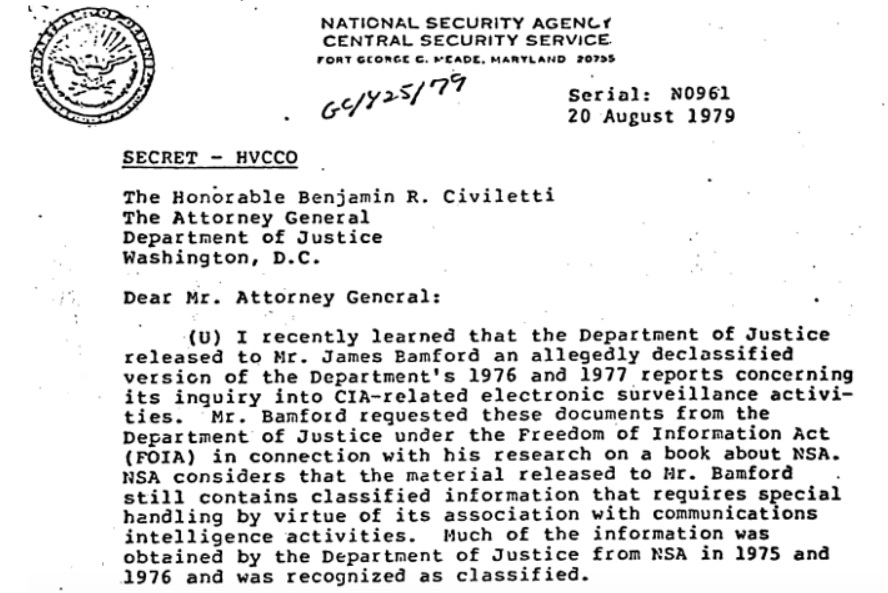
In the course of his research for what would eventually become The Puzzle Palace: Inside the National Security Agency, America’s Most Secret Intelligence Organization, Bamford filed a number of FOIA requests. These included one to the Department of Justice which resulted in the release of the DOJ’s probe into CIA and NSA’s abuse of electronic surveillance. The DOJ fulfilled the request and released a considerable amount of information on CIA’s and NSA’s activities. Since the information was part of an ongoing investigation, the DOJ decided not to notify the NSA since it would be informing them of the details of the investigation. (It’s unclear why the DOJ didn’t withhold the information under b(7)(a).

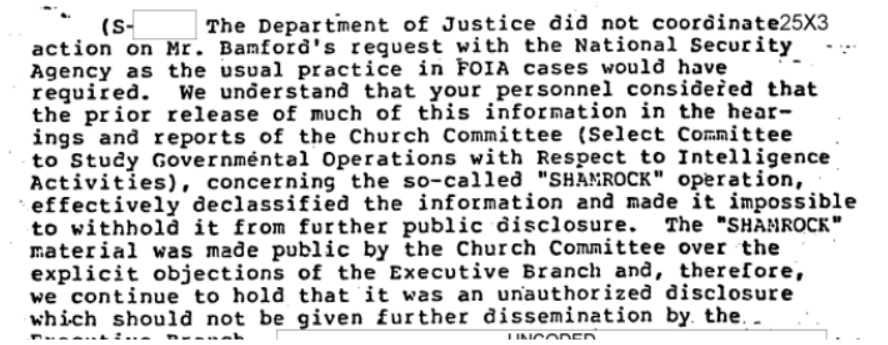
While the NSA contended that the information remained classified, a 1979 letter from the NSA Director to the Attorney General admitted that the DOJ “effectively declassified the information and made it impossible to withhold from further public disclosure.” Nevertheless, within a few years not only did the NSA try to prevent further disclosure, it looked to prosecute the journalist responsible, despite acknowledging that the “classified information” was “effectively declassified.” According to the NSA, since the information had been declassified by the Church Committee “over the objections of the Executive Branch”, the information was therefore still classified and any disclosure was unauthorized.
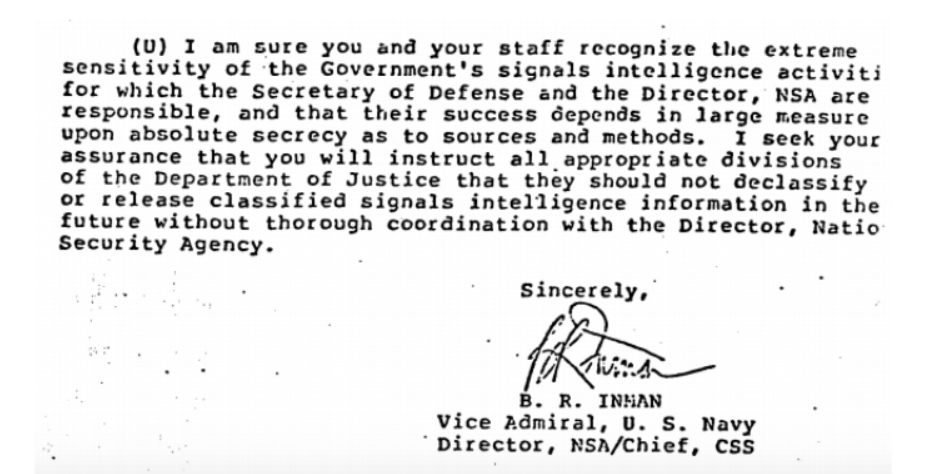
The 1979 letter to the AG ends with Vice Admiral Inman asking that the DOJ respect the “absolute secrecy as to sources and methods.” The Intelligence Community’s legal right to protect its sources and methods was well recognized, but in this instance it may have been poorly asserted.
Three years prior, the IC had put into place its specific guidelines on protecting sources and methods, going so far as to produce a list of 126 types of sources and methods information (and non-sources and methods information which they decided to include as well) which needed to be protected. A directive signed by the CIA Director asserted that while sources and methods needed to be protected, this didn’t apply to “information relating to any Agency activity or operation which violates a U.S. statute, Executive order or Presidential order or is without authority of law.” Any such information “cannot be withheld.”
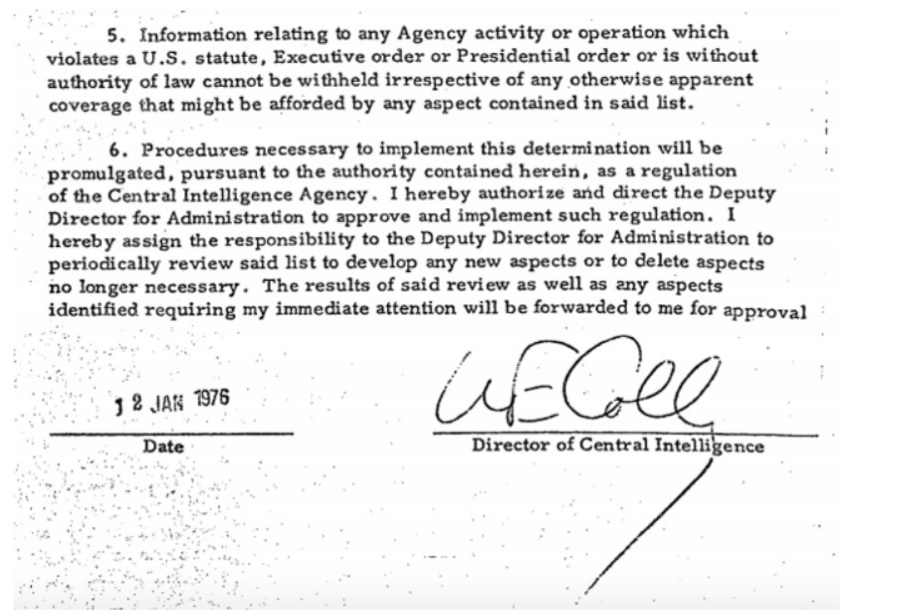
While not an NSA directive, it establishes precedence for the IC by showing that, even by the CIA’s standards, NSA had no right to request that the information be withheld to protect their sources and methods. According to the DOJ’s report, the NSA appeared to have violated several statutes. Despite acknowledging the possibility of some defenses, including citing ignorance of the law as a possible defense, a line of reasoning which would later be upheld in a separate case.
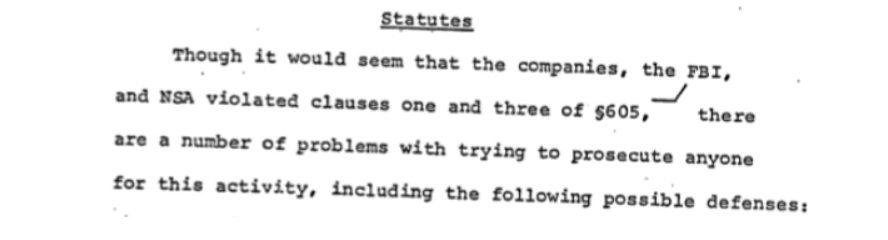
Regardless of the propriety of the sources and methods or NSA’s willingness to defend the “effectively declassified” information as classified, the NSA sought to prevent the publication of Bamford’s book. According to a 1981 letter sent by the NSA Director to the DOJ, the NSA learned that Bamford had the document when he informed one of their employees in August 1979. (Bamford has identified this employee as George Gapp, a GCHQ employee assigned to liaise with NSA.) This prompted prompted the NSA’s initial letter to the AG.
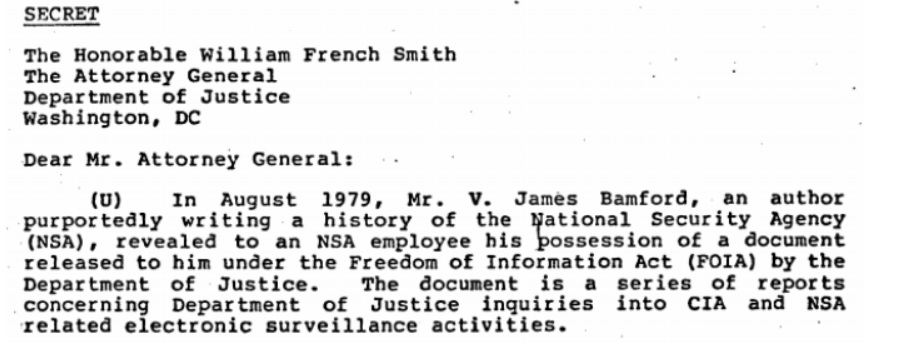
Apparently, the AG never responded to the initial letter.

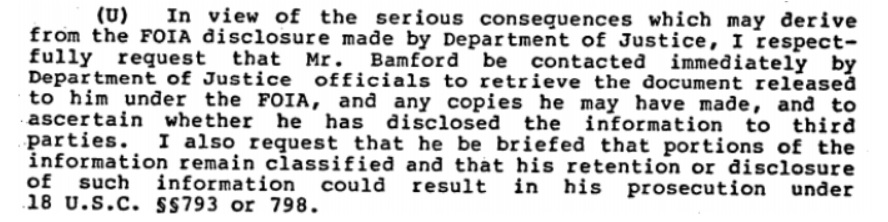
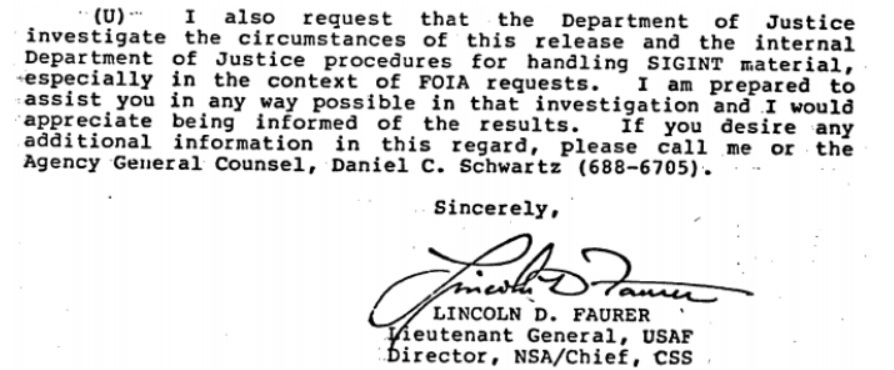
Due to “the serious consequences” of the FOIA disclosure, the NSA Director asked that the DOJ immediately contact Bamford to retrieve the documents along with all copies and to learn who else had that information. The NSA Director also requested that the DOJ tell Bamford “that his retention or disclosure of such information could result in his prosecution under 18 U.S.C. 793 or 798,” which are better known as the Espionage Act.
The NSA Director also requested that the DOJ “investigate the circumstances of this [FOIA] release.”
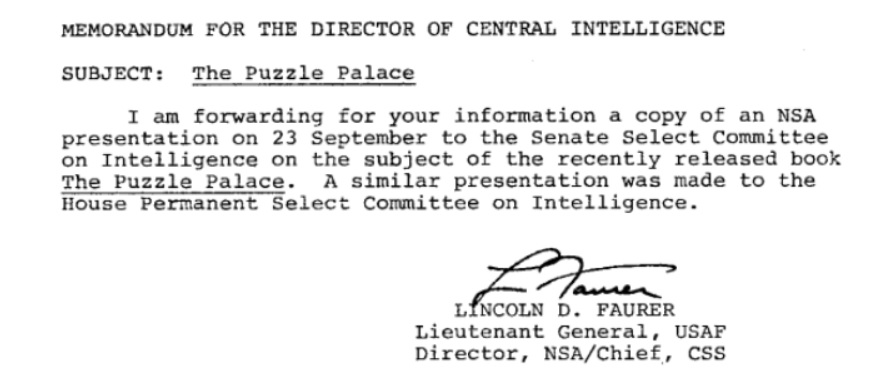
A September 1982 Congressional briefing for both the Senate and House intelligence committees and sent to the CIA Director shows that the desire to prosecute Bamford under the Espionage Act wasn’t a passing thought, but a long-term desire of the NSA’s.
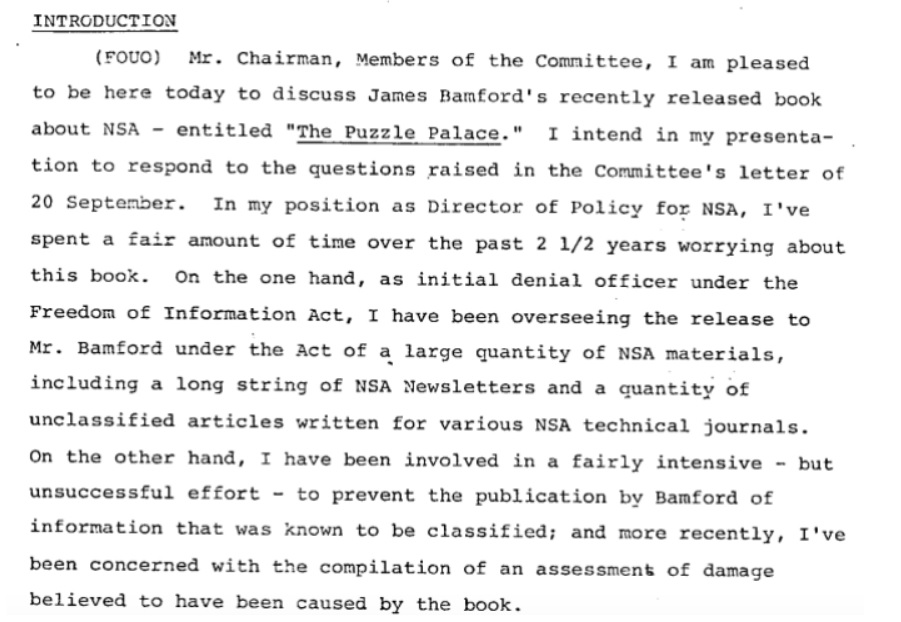
According to the NSA’s Director of Policy, they had spent two and a half years on the issue, including “a fairly intensive - but unsuccessful effort - to prevent the [book’s] publication.”
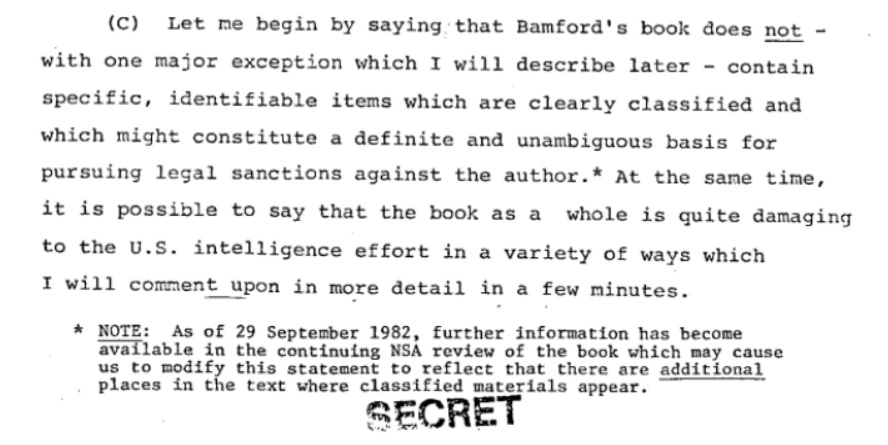
When the briefing was first delivered on September 23rd, the NSA’s Director of Policy stated that the NSA had only found one “definite and unambiguous basis for pursuing legal sanctions” against Bamford. By the 29th, this statement had been given a caveat stating that additional information “became available in the continuing NSA review of the book which may cause us to modify this statement to reflect that there are additional” instances of classified information, though as of the most recently produced document, this remained only a hypothetical possibility.
The briefing proceeds to accuse the book of being a “mixture of fact and fiction” without identifying what the fiction is. Instead of discussing the allegedly classified information or the supposed fiction of the book, the briefing proceeds to assault the book for giving readers the impression that the NSA is able to monitor the communications of U.S. citizens.
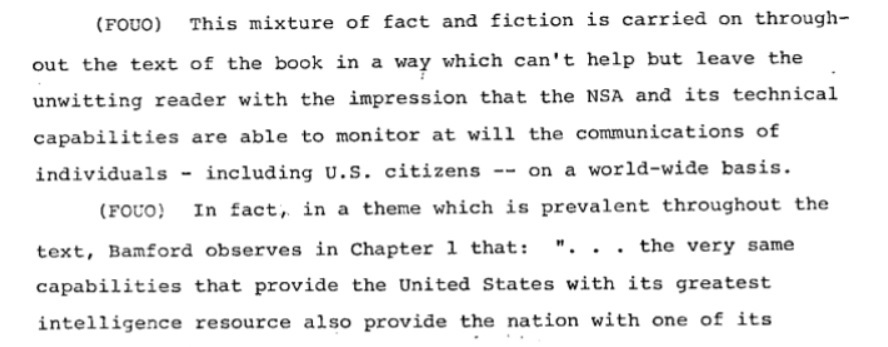
As the NSA’s Director of Policy pointed out, “this is not a very reassuring picture.”
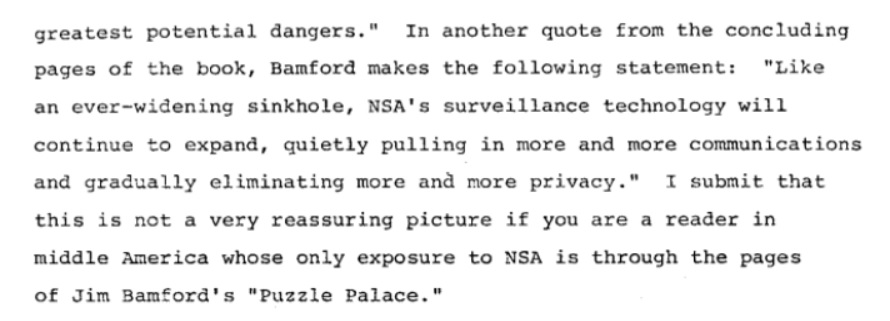
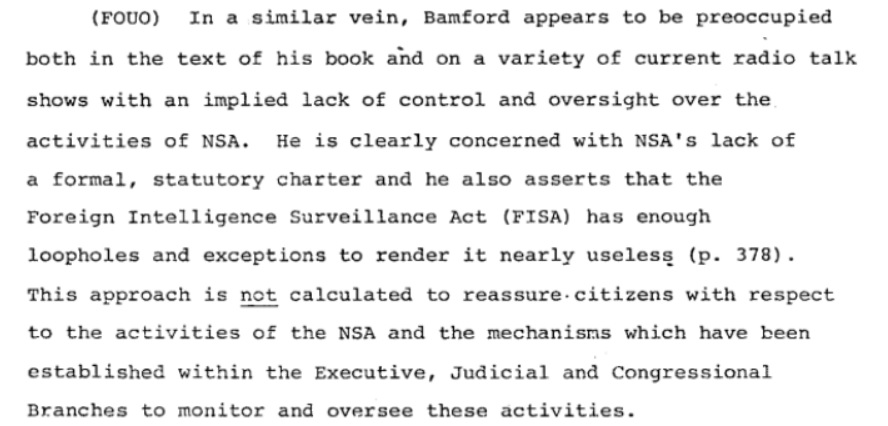
The Director of Policy continued on, stating that Bamford’s concern “with NSA’s lack of a formal, statutory charter” and FISA loopholes “is not calculated to reassure citizens with respect to the activities of the NSA.”
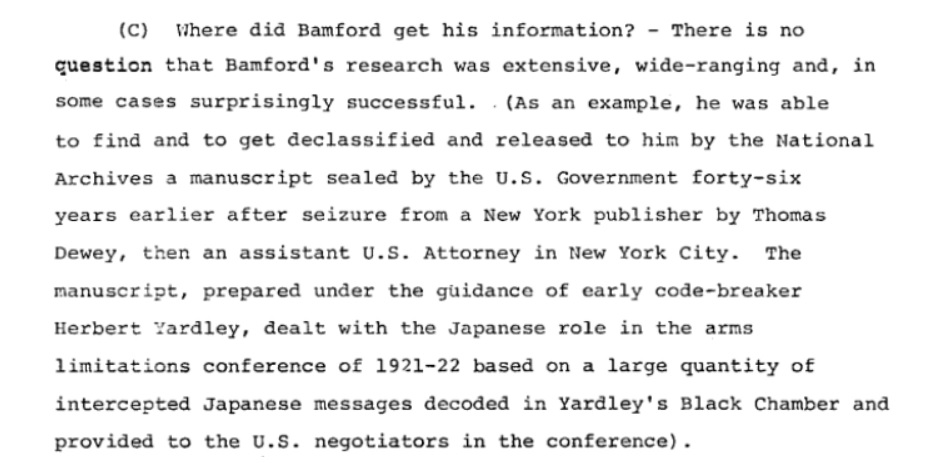
When discussing Bamford’s research, the NSA’s Director of Policy makes sure to note that Bamford had much of his information declassified and released to him.
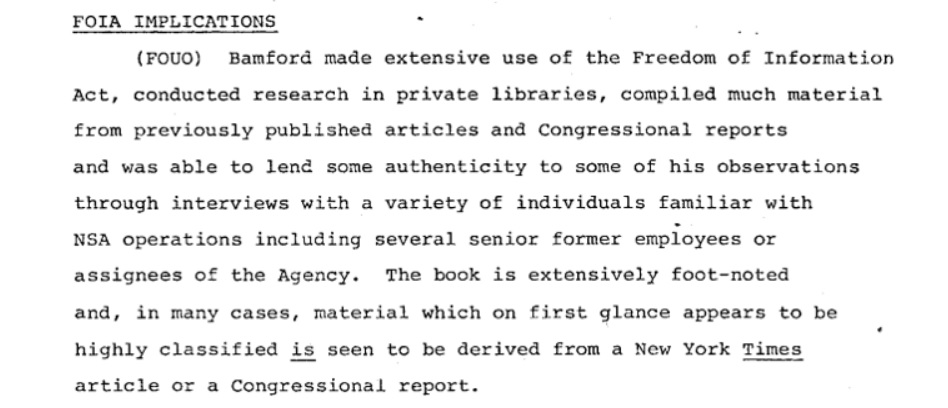
They also note that other information “which on first glance appears to be highly classified” actually came from the New York Times articles and Congressional reports.
As a result of learning about the DOJ’s FOIA release, the NSA and DOJ arranged a series of meetings with Bamford. According to the NSA, the July meeting went well, though their next meeting did not. According to Bamford, he walked out of the meeting while his lawyer distracted the government officials, fearing that they might have a warrant, subpoena or restraining order which they might serve Bamford with. As a result, the DOJ sent Bamford a letter informing him that the DOJ had concluded “it was his duty and obligation as a U.S. citizen to return the information to the Department of Justice.”
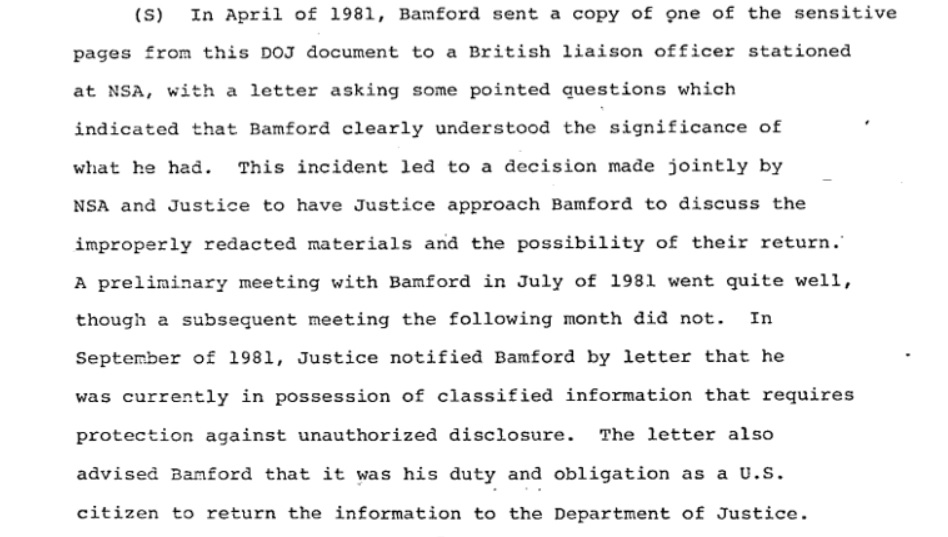
Bamford and his ACLU lawyer refused to comply, and published the book to the NSA’s embarrassment and the GCHQ’s immense frustration.
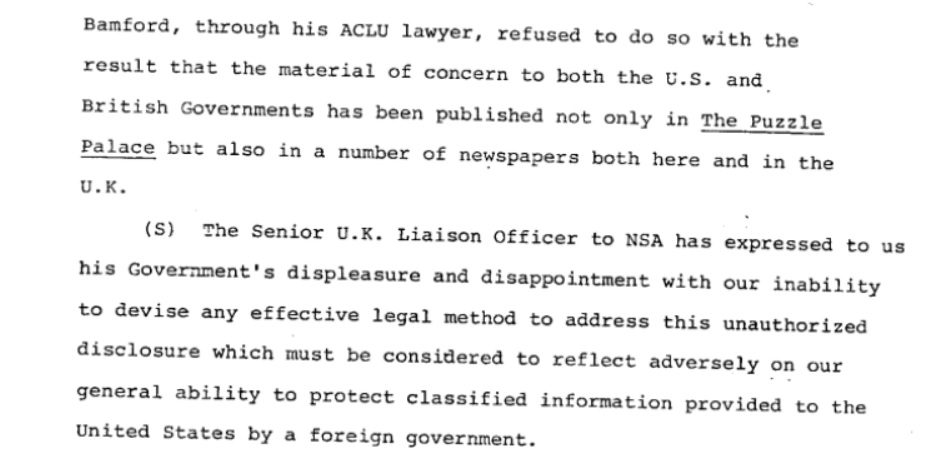
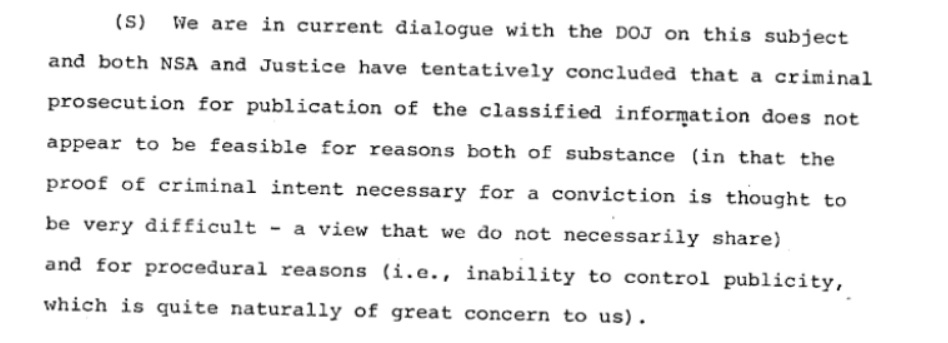
As of the September 1982 briefing, more than a year after first threatening Bamford under the Espionage Act, the NSA was still “in current dialogue with the DOJ” on the matter. The DOJ had apparently concluded that it would not be feasible to prove the “criminal intent necessary for a conviction,” a view which the NSA’s Director of Policy notes they “do not necessarily share.” The NSA’s greater concern was their inability to control the publicity that would come from such ap prosecution, since it would raise the profile of the objectionable information while also making them look extremely bad for using the Espionage Act to prosecute the use of the FOIA.
At no point in the briefing or the declassified letters does NSA reference a desire to see the DOJ to prosecute its employees under the Espionage Act for releasing the information to Bamford.

According to the briefing delivered by NSA’s Director of Policy, the DOJ’s conclusion that an Espionage Act prosecution was impractical wasn’t the end of the NSA’s desire to twist the law in order to go after Bamford for his use of FOIA. According to the briefing, the NSA had just “recently learned” that Bamford had served with the Naval Security Group. In the NSA’s eyes, this “could provide the basis for a Snepp-type civil proceeding,” referring to CIA suing Frank Snepp for breach of contract over his non-disclosure agreement. The Director of Policy states that in addition to coordinating with the DOJ on this, they had also received information from the Navy which was “germane to a possible civil action,” a possibility which NSA was still investigating.
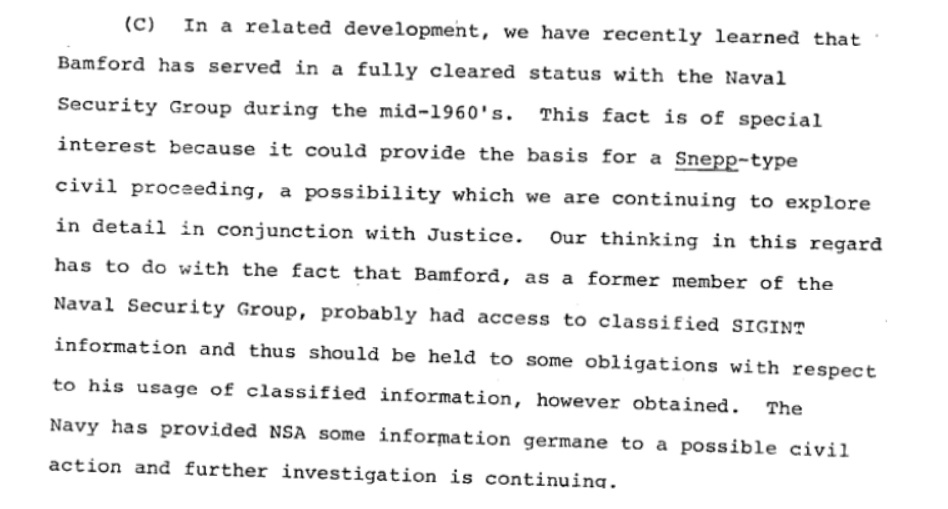
Where the Snepp case appears to have revolved around information Snepp obtained while employed for the Agency, which would thus be subject to the NDA, not only does the NSA offer no evidence that Bamford used any information he gained during his time with the Naval Security Group, it offers proof that he didn’t.

In its briefing to Congress, the NSA argues that the sources and methods used by Bamford in researching his book - methods which NSA wanted to prosecute him for - were ones “easily available to any serious researcher.” These included “unclassified or declassified records in the National Archives and public libraries” along with Congressional reports, the FOIA and interviews which Bamford had conducted.
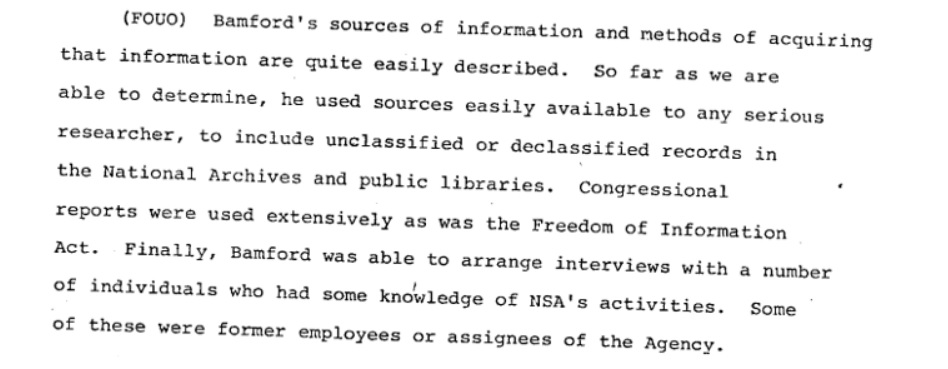
The briefing then turns towards condemning Bamford’s use of unclassified information to put together a mosaic, a classic argument against FOIA.
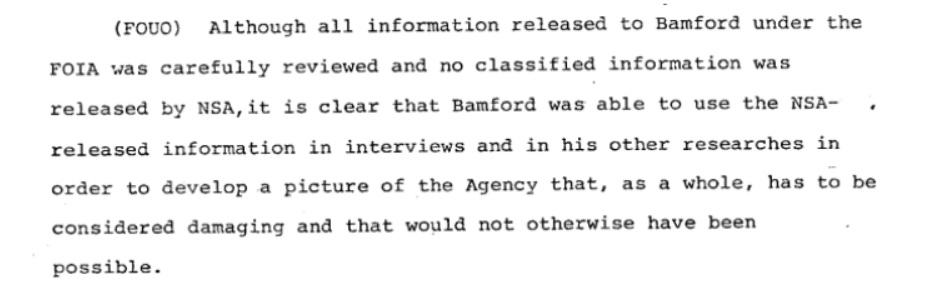
The briefing indicates that the NSA was more than ready to disregard “DOJ’s skepticism” about successfully prosecuting Bamford, saying “it is clear that Mr. Bamford violated [the Espionage Act] by publishing” his book.
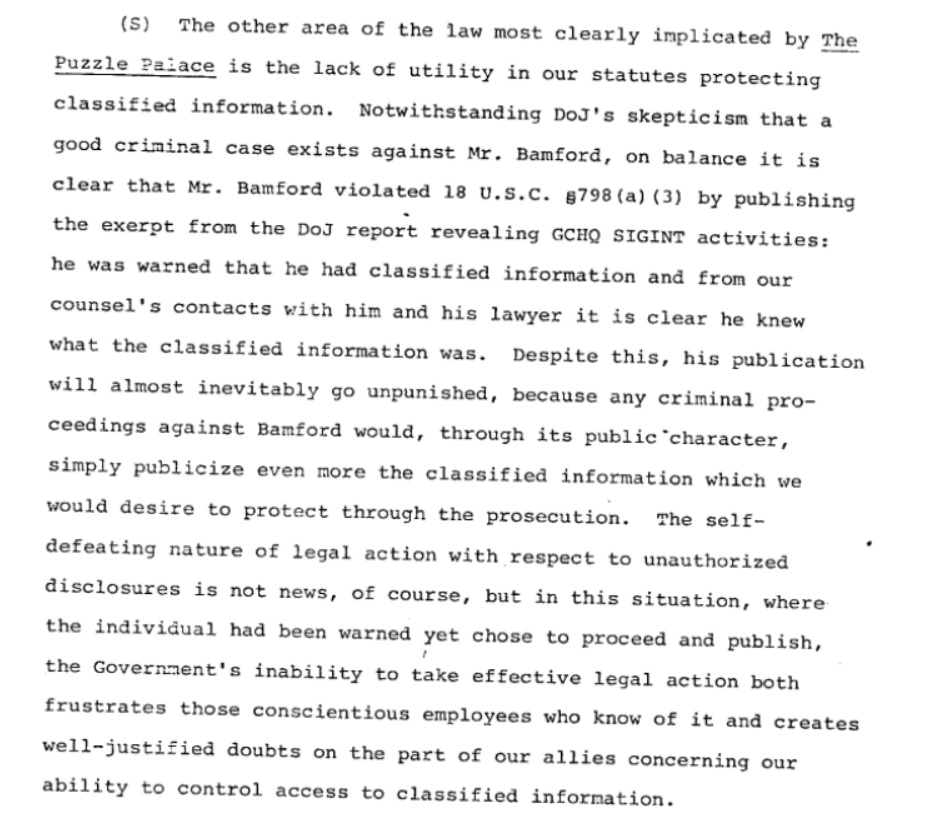
According to the damage assessment included in the briefing, the NSA acknowledged that none of the information was likely to result in harm “because of the lack of specificity or the datedness of the material.” Nevertheless, seeing “compiling such information into a single document” could encourage the NSA’s targets to upgrade their security.
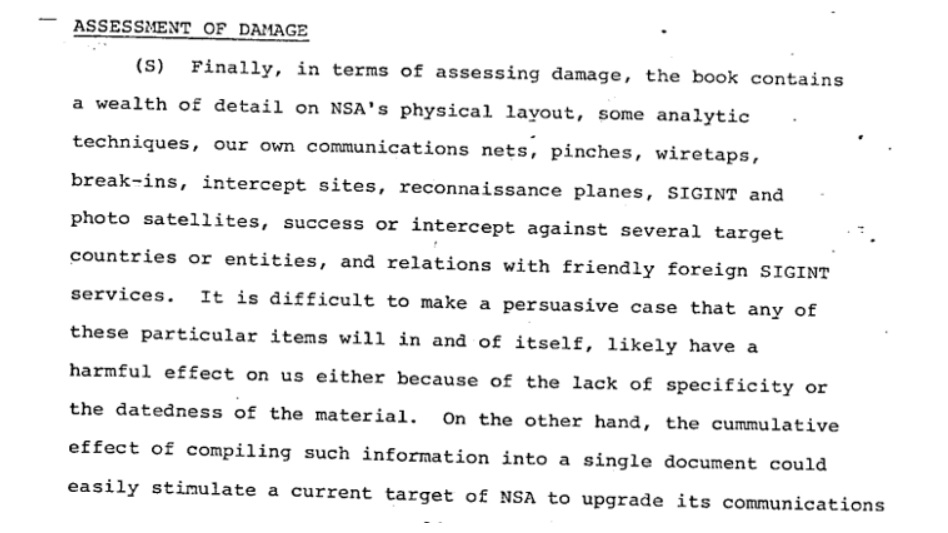
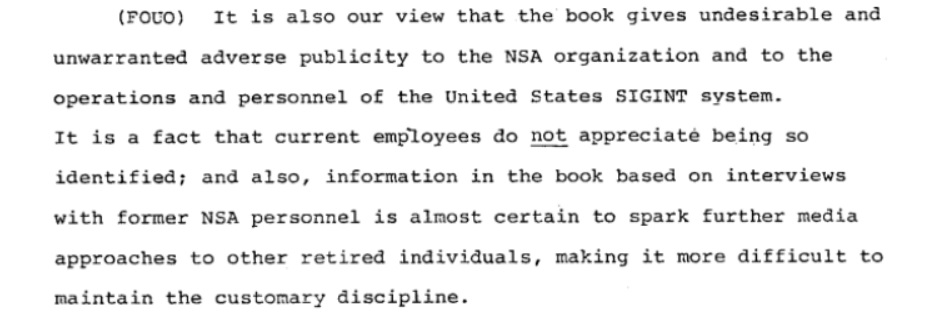
The only specific damage cited is the “undesirable and unwarranted adverse publicity to the NSA organization.” The damage also included the fact that employees “do not appreciate” being identified.
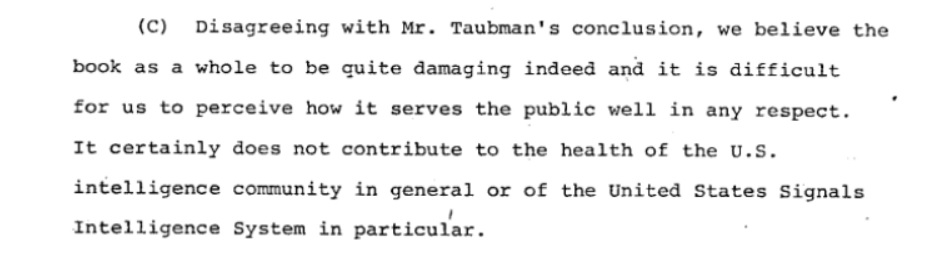
After stating that no particular piece of information in the book was damaging, the NSA’s Director of Policy argued that “the book as a whole” was “quite damaging. The NSA disagreed with book reviews which saw The Puzzle Palace as performing “an important public service,” saying that it was “difficult for us to perceive how it serves the public well in any respect.” It appears that the NSA defines serving the public as contributing to “the health of the U.S. intelligence community” and its ability to intercept communications.
Where a CIA Director would later argue against using the Espionage Act to target people who leaked to the media, the NSA Director and its Director of Policy wanted to use it to target people who used FOIA. Regretting the release of the information, the NSA wanted to put the toothpaste back into the tube and was willing to explore any legal argument possible to do so. By asserting that the DOJ’s allegedly improper release of information to Bamford opened him - but not the person who released the information to him - to espionage charges, the NSA was laying the groundwork for bringing similar charges against any journalist who was able to legally compile enough information to trigger the mosaic approach.

According to the mosaic theory, “compilations of otherwise unclassified information may be classified” if the combined information could theoretically result in additional inferences that would be equivalent to classified information. This theory, applied widely, would likely make much of MuckRock’s work with the declassified CREST archive subject to charges under the Espionage Act.
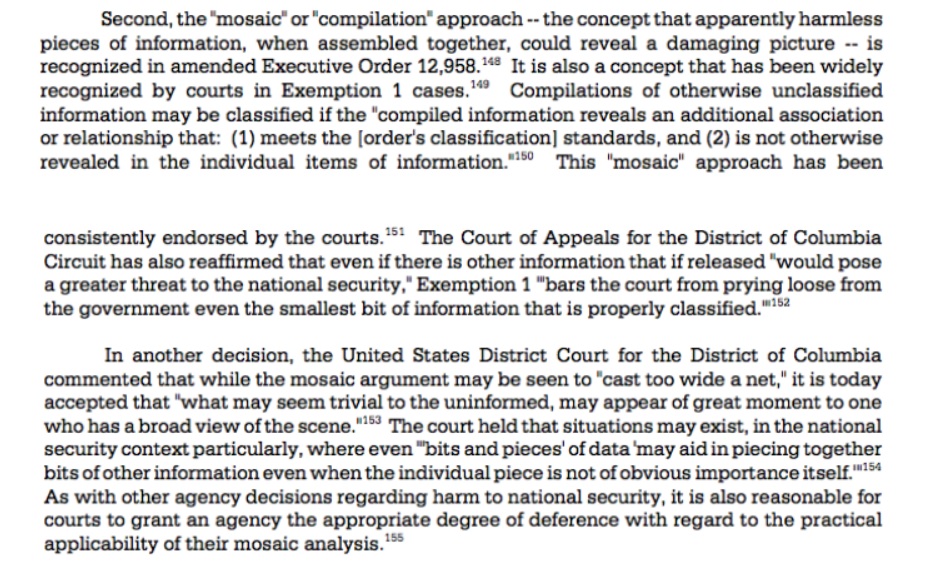
MuckRock’s work with CREST, after all, certainly includes compiling “bits and pieces” of data in ways that “may aid in piecing together bits of other information even when the individual piece is not of obvious importance itself.”

If the NSA had successfully followed through on its desire to bring a “Snepp-like” civil proceeding against Bamford in this case would likely have created a new ability to censor the reporting of anyone who had worked for the government and signed a non-disclosure agreement, regardless of their actual source of information.

More alarmingly, however, would have been the government’s ability to use the Espionage Act to silence any outlet. The argument that an accidental disclosure not only didn’t count but could be legally recalled and prosecuted could be applied to almost any circumstance. To take it to its absurd (yet inevitable) conclusion, any statement or admission could be recalled and news organizations prevented from reporting on it. Unlike the FOIA review and redaction process, government spokesperson and press secretaries don’t spend months preparing each statement. It would be far easier to argue an accidental admission or procedural in that regard, without the months of deliberation.

While that possibility sounds absurd on the surface, it’s no more laughable than using the Espionage Act to prosecute a journalist for using the FOIA. The DOJ’s objections to doing so weren’t based on any perceived legal or moral reasons, but rather on the optics and the difficulty of proving the case in court. Since then the Intelligence Community has acted to limit FOIA, with CIA going as far as saying that FOIA fell outside of “official channels.” Their desire to use an unrelated NDA against Bamford highlights the same issue, and if pursued again would threaten to silence any journalist who had previously worked for the U.S. Government or military in any sensitive capacity, whether or not it was related to their journalism.

Nor is the tendency to prosecute citizens for using sunshine laws a thing of the past. MuckRock’s founder, Michael Morisy, was once threatened with imprisonment for publishing documents MuckRock received in response to a public records request. Other requesters have similarly been threatened with legal sanctions for receiving documents in response to their public records requests. The willingness of state and local governments to use these tactics is disturbing when combined with the federal government’s similar assertions.

This willingness, combined with Executive Order 12356 (signed by President Reagan in response to Bamford’s research) which allows the government to reclassify information, is an ongoing - albeit dormant - threat not only to journalism, but to free speech as a whole.


e-max.it: your social media marketing partner
 
<< Start < Prev 1451 1452 1453 1454 1455 1456 1457 1458 1459 1460 Next > End >>

Page 1457 of 3432

THE NEW STREAMLINED RSN LOGIN PROCESS: Register once, then login and you are ready to comment. All you need is a Username and a Password of your choosing and you are free to comment whenever you like! Welcome to the Reader Supported News community.

RSNRSN