


Intro: "Few realise that foreign governments gain the right to our personal data when we sign up to social media. This must end."

Twitter bird on branch artwork, 06/15/09. (art: Twitter)

The US Justice Department Hacked My Twitter Account
13 November 11
Few realise that foreign governments gain the right to our personal data when we sign up to social media. This must end.
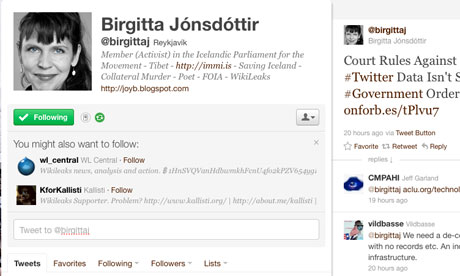
Birgitta Jónsdóttir's Twitter account: A US court has ruled that Twitter must comply with a Department of Justice demand
to release private data held by the social media company, which it seeks as part of its investigation into WikiLeaks.
(photo: Guardian UK)
 efore my Twitter case, in which the US Department of Justice has demanded that the social media site hands over personal information about my account which it deems necessary to its investigation of WikiLeaks, I didn't think much about what rights I would be signing off when accepting user agreement in my computer. The text is usually lengthy, in a legal language that most people don't understand. Very few people read the user agreements, and very few understand their legal implications if someone in the real world would try to use one against them.
Many of us who use the internet - be it to write emails, work or browse its growing landscape: mining for information, connecting with others or using it to organise ourselves in various groups of the like-minded - are not aware of that our behavior online is being monitored. Profiling has become a default with companies such as Google and Facebook. These companies have huge databases recording our every move within their environment, in order to groom advertising to our interests. For them, we are only consumers to push goods at, in order to sell ads through an increasingly sophisticated business model. For them, we are not regarded as citizens with civic rights.
This notion needs to change. No one really knew where we were heading a few years ago: neither we the users, nor the companies harvesting our personal information for profit. Very few of us imagined that governments that claim to be democratic would invade our online privacy with no regard to the fundamental rights we are supposed to have in the real world. We might look to China and other stereotypical totalitarian states and expect them to violate the free flow of information and our digital privacy, but not - surely? - our very own democratically elected governments.
What I have learned about my lack of rights in the last few months is of concern for everyone who uses the internet and calls for actions to raise people's awareness about their legal rights and ways to improve legal guidelines about digital media, be it locally or globally. The problem - and the dilemma we are facing - is that there are no proper standards, no basic laws in place that deal with the fundamental question: are we to be treated as consumers or citizens online? There is no international charter that says we should have the same civic rights as we have in the offline world.
Our legal systems are slow compared to the speed of online development. With the social media explosion, many people have put into databases very sensitive information about themselves and others without knowing that they have no rights to defend themselves against attempts by governments to obtain that personal data - whether their own local authorities or, as in my case, a foreign government acting internationally. According to the ruling of the US federal judge in my Twitter case, we have fortified those rights of government agencies when we agreed to the terms and conditions set by the company hosting our data. Even if that information is not held on servers in the US, the company would only need to have an office in the US for authorities to be able to demand its release to them.
So, we have to rely on, for example, Amazon, Facebook, Google and Twitter to look out for our interests. But it might not always be in their interests to look out for us.
The reason we make international treaties and declarations about human rights is because, somewhere along the line, we agreed that certain rights are sacred and universal. We need to make the same principles applicable to our human rights online, as they are offline. These two worlds have fused together, and there is no way to define them as separate anymore.
If is too easy for governments to access the information stored online, it is too easy for that access to be abused. If someone wanted to go through all my regular mail, they would have to obtain a search warrant in advance. No such thing happened in the Twitter case. I am, according to the US Justice Department, not under a criminal investigation, yet its officials demanded Twitter surrender my personal messages and IP numbers without my knowledge. It has never been so easy for Big Brother to pry on all our most sacred information without us ever even knowing.


|
THE NEW STREAMLINED RSN LOGIN PROCESS: Register once, then login and you are ready to comment. All you need is a Username and a Password of your choosing and you are free to comment whenever you like! Welcome to the Reader Supported News community. |


