Written by <a href="index.php?option=com_comprofiler&task=userProfile&user=19173"><span class="small">Michael Cohen, Guardian UK</span></a>
Friday, 22 June 2012 15:13
Cohen writes: "After watching Mitt Romney run for president the past few months, he makes John McCain look like George Washington (of 'I Can't Tell A Lie' fame)."
When challenged about an untruthful statement, Romney's tactic is to deny he said it - lie trumping lie, writes Michael Cohen. (photo: YouTube/BarackObama.com)
Romney's Bid to Become Liar-in-Chief
By Michael Cohen, Guardian UK
22 June 12
our years ago, when I was writing about the 2008 presidential campaign, I wrote with dismay and surprise at the spate of falsehoods coming out of John McCain's campaign for president. McCain had falsely accused his opponent Barack Obama of supporting "comprehensive sex education" for children, and of wanting to raise taxes on the middle class, while his running mate, Alaska Governor Sarah Palin, took credit for opposing the so-called "Bridge to Nowhere", which she had actually supported.
At the time, such false and misleading claims from a presidential candidate seemed shocking: they crossed an unstated line in American politics – going from the usual garden-variety campaign exaggeration to wilful lying.
Ah, those were the days … after watching Mitt Romney run for president the past few months, he makes John McCain look like George Washington (of "I Can't Tell A Lie" fame).
Granted, presidential candidates are no strangers to disingenuous or overstated claims; it's pretty much endemic to the business. But Romney is doing something very different and far more pernicious. Quite simply, the United States has never been witness to a presidential candidate, in modern American history, who lies as frequently, as flagrantly and as brazenly as Mitt Romney.
Now, in general, those of us in the pundit class are really not supposed to accuse politicians of lying – they mislead, they embellish, they mischaracterize, etc. Indeed, there is natural tendency for nominally objective reporters, in particular, to stay away from loaded terms such as lying. Which is precisely why Romney's repeated lies are so effective. In fact, lying is really the only appropriate word to use here, because, well, Romney lies a lot. But that's a criticism you're only likely to hear from partisans.
My personal favorite in Romney's cavalcade of untruths is his repeated assertion that President Obama has apologized for America. In his book, appropriately titled "No Apologies", Romney argues the following:
"Never before in American history has its president gone before so many foreign audiences to apologize for so many American misdeeds, both real and imagined. It is his way of signaling to foreign countries and foreign leaders that their dislike for America is something he understands and that is, at least in part, understandable."
Nothing about this sentence is true.
President Obama never went around the world and apologized for America – and yet, even after multiple news organizations have pointed out this is a "pants on fire" lie, Romney keeps making it. Indeed, the "Obama apology tour", along with the president bowing down to the King of Saudi Arabia, are practically the lodestars of the GOP's criticism of Obama's foreign policy performance (the Saudi thing isn't true either).
But foreign policy is a relatively light area of mistruth for the GOP standard-bearer. The economy is really where the truth takes its greatest vacation in Romney world. First, there is Romney's claim that the 2009 stimulus passed by Congress and signed by President Obama "didn't work". According to Romney, "that stimulus didn't put more private-sector people to work." While one can quibble over whether the stimulus went far enough, the idea that it didn't create private-sector jobs has no relationship to reality. According to the Congressional Budget Office, the stimulus bill created more than 3m jobs – a view shared by 80% of economists polled by the Chicago Booth School of Business (only 4% disagree).
Romney also likes to argue that the stimulus didn't help private-sector job growth, but rather helped preserve government jobs. In fact, the Obama years have been witness to massive cuts in government employment. While the private sector is not necessarily "doing fine", as Obama said in a recent White House press conference, it's doing a heck of a lot better than the public sector.
Romney took credit for the success of the auto bailout – even though he wrote an op-ed for the Washington Post titled "Let Detroit Go Bankrupt". He's said repeatedly that businesses in America see Obama as the "enemy", and that under his presidency "free enterprise" and economic freedom" are at risk of disappearing. In reality, since taking office, corporate profits, industrial production and the stock market are up, while corporate bankruptcies have actually decreased.
Then, there is the recent Romney nugget that the Obama administration passed Obamacare with the full knowledge that it "would slow down the economic recovery in this country" and that the White House "knew that before they passed it". It's an argument so clearly spun from whole cloth that according to Jonathan Chait, the acerbic political columnist for New York Magazine, Romney is "Just Making Stuff Up Now".
Also of Obamacare, Romney has said that it will lead to the government taking over 50% of the economy (not true) – its true cost can't be computed (that's why we have a Congressional Budget Office in the United States); that it will create to "a massive European-style entitlement" (many liberals wish this were true, but alas, it is not); and that it will lead to a government-run healthcare system (a lie so pervasive that it's practically become shorthand for Republicans – yet it too, like the infamous made-up death panels of the health care debate, is simply not accurate).
The lying from the Romney campaign is so out-of-control that Steve Benen, a blogger and producer for the Rachel Maddow show compiles a weekly list of "Mitt's Mendacity" that is chockfull of new untruths. Benen appears unlikely to run out of material any time soon, particularly since Romney persists in repeating the same lies over and over, even after they've been debunked.
This is perhaps the most interesting and disturbing element of Romney's tireless obfuscation: that even when corrected, it has little impact on the presumptive GOP nominee's behavior. This is happening at a time when fact-checking operations in major media outlets have increased significantly, yet that appears to have no effect on the Romney campaign.
What is the proper response when, even after it's pointed out that the candidate is not telling the truth, he keeps doing it? Romney actually has a telling rejoinder for this. When a reporter challenged his oft-stated assertion that President Obama had made the economy worse (factually, not correct), he denied ever saying it in the first place. It's a lie on top of a lie.
Now, it's certainly true that on the campaign trail, facts can be stretched in many different directions – and both parties, including President Obama, frequently make arguments that are misleading, lacking in context or simply false. But it is virtually unheard of for a politician to lie with such reckless abandon and appear completely unconcerned about getting caught.
Back in the old days (that is, pre-2008) it would have been considered unimaginable that a politician would lie as brazenly as Romney does – for fear of embarrassment or greater scrutiny. When Joe Biden was accused of plagiarizing British Labor Leader Neil Kinnock's speeches in 1988, it derailed his presidential aspirations. When Al Gore was accused of exaggerating his role in "inventing the internet" (which, actually, was sort of true), it became a frequent attack line that hamstrung his credibility. Romney has done far worse than either of these candidates – yet it's hard to discern the negative impact on his candidacy.
Romney has figured out a loophole – one can lie over and over, and those lies quickly become part of the political narrative, practically immune to "fact-checking". Ironically, the more Romney lies, the harder it then becomes to correct the record. Even if an enterprising reporter can knock down two or three falsehoods, there are still so many more that slip past.
It's reminiscent of the old line that a lie gets halfway around the world before the truth gets its boots on. In Romney's case, his lies are regularly corrected by media sources, but usually, in some antiseptic fact-checking article, or by Democratic/liberal voices who can be dismissed for their "partisan bent". Meanwhile, splashed across the front page of newspapers is Romney saying "Obamacare will lead to a government take-over of healthcare"; "Obama went on an apology tour"; or "the stimulus didn't create any jobs". Because, after all, it's what the candidate said and reporters dutifully must transcribe it.
Pointing out that Romney is consistently not telling the truth thus risks simply falling into the category of the usual "he-said, she-said" of American politics. For cynical reporters, the behavior is inevitably seen to be the way the political game is now played. Rather than being viewed and ultimately exposed as examples of a pervasive pattern of falsehoods, Romney's statements embed themselves in the normalized political narrative – along with aggrieved Democrats complaining that Romney isn't telling the truth. Meanwhile, the lie sticks in the minds of voters.
As MSNBC's Steve Benen told me:
"Romney gets away with it because he and his team realize contemporary political journalism isn't equipped to deal with a candidate who lies this much, about so many topics, so often."
Romney is charting new and untraveled waters in American politics. In the process, he is cynically eroding the fragile sense of trust that exists between voters and politicians. It's almost enough to make one pine for the days when Sarah Palin lied about "the Bridge to Nowhere".
FOCUS: Karl Rove Complains to Fox About Executive Privilege
Friday, 22 June 2012 13:27
Johnson writes: "In an appearance today on America's Newsroom, Fox News contributor Karl Rove expressed concern that President Obama's assertion of executive privilege over a set of Department of Justice internal documents was a novel expansion of the doctrine. The former senior advisor to President George W. Bush was ill-equipped to make this claim, as Bush invoked the privilege under similar circumstances while Rove was his top political advisor."
Dear friends: Former US President George W. Bush and Karl Rove. (photo: ABC News)
Karl Rove Complains to Fox About Executive Privilege
By Timothy Johnson, Media Matters
22 June 12
n an appearance today on America's Newsroom, Fox News contributor Karl Rove expressed concern that President Obama's assertion of executive privilege over a set of Department of Justice internal documents was a novel expansion of the doctrine. The former senior advisor to President George W. Bush was ill-equipped to make this claim, as Bush invoked the privilege under similar circumstances while Rove was his top political advisor.
KARL ROVE, FOX NEWS CONTRIBUTOR: It's one thing to exert executive privilege over the actions of the President, and his aides, and the White House. It's another thing to exercise executive privilege with regard to aCabinet official, seemingly in a matter that according to the President up until now, had no connections with, no contact with, no communications with the White House. So I'm a little bit concerned about it. I think it's an overreach.
[...]
ROVE: This is a very long reach. I mean basically if the President is allowed to take the privilege that goes to the Executive Office of the President and extend it to a Cabinet department, then he can extend it to any branch of the government for any matter, even if there was no presidential or White House involvement. And I'm not certain that that's what the Founders thought about when they talked about executive privilege.
Rove either forgot that the first time Bush invoked executive privilege it was in regards to Justice Department internal documents, or was being deliberately deceptive. In December 2001 the New York Times reported:
President Bush invoked executive privilege today for the first time in his administration to block a Congressional committee trying to review documents about a decades-long scandal involving F.B.I. misuse of mob informants in Boston. His order also denied the committee access to internal Justice Department deliberations about President Bill Clinton's fund-raising tactics.
As noted by law professor Peter Shane, an expert on the separation of powers, executive privilege routinely encompasses "documents generated anywhere in the executive branch":
Executive privilege is really an umbrella concept that encompasses a variety of privileges. History's most famous claim of executive privilege -- President Richard Nixon's unsuccessful attempt to withhold the "Watergate tapes" -- was an example of "presidential privacy" privilege. That privilege covers executive communications when the president is involved.
The executive branch, however, historically claims a much broader privilege, the so-called "deliberative privilege."
Deliberative privilege aims to protect documents generated anywhere in the executive branch that embody only the executive's internal deliberations, not final policy decisions. The current dispute involves "deliberative privilege."
During his appearance, Rove also ran with the latest right-wing conspiracy, suggesting that Obama's assertion of executive privilege indicates that he was involved in Fast and Furious while the operation was ongoing. Media Mattershas previously noted that these claims are false. The president asserted executive privilege only over documents created after the failed operation was ended.
Written by <a href="index.php?option=com_comprofiler&task=userProfile&user=5903"><span class="small">Michael Tomasky, The Daily Beast</span></a>
Thursday, 21 June 2012 15:19
Tomasky reports: "Republicans like to denounce the so-called extremism of the liberal Warren Court. But the 5-4 decisions of the Roberts Court are the most divisive in American history."
Supreme Court Justice Antonin Scalia. (photo: AP)
Radicals on the Supreme Court
By Michael Tomasky, The Daily Beast
21 June 12
s we gather in our respective bunkers awaiting the white smoke from the Supreme Court, I thought a little history discussion might be in order. We’ve heard conservatives say many times that the Warren Court overreached, legislated from the bench, and divided America. It’s typically called the most controversial court in American history, and we know the reasons why. But the numbers tell a very different story. Even though Roberts has reigned on Maryland Avenue for just seven years as opposed to Earl Warren’s 16, the Roberts nonet (more accurately, quintet) has issued far more aggressive and in-your-face 5-4 rulings on controversial and high-profile cases and done far more to divide the country. I don’t know what they’ll do on health care, but they already deserve to displace the Warren Court in the controversy sweepstakes.
Tim Sloan / AFP-Getty Images
First I looked at eight representative and major Roberts Court decisions in hot-button issue areas.
Race: Parents v. Seattle & Meredith v. Jefferson, which began as two cases and were eventually combined into one, also known as the Seattle/Louisville desegregation case. The Court ruled that local school districts basically couldn’t do anything to ensure racial diversity in their schools.
Abortion: Gonzales v. Carhart upholding the federal partial-birth abortion ban.
Campaign finance: Citizens United vs. Federal Elections Commission, which prohibited restrictions on many independent expenditures; also McCain v. Wisconsin Right to Life, which weakened key provisions of the McCain-Feingold law.
Equal Rights: Ledbetter v. Goodyear, which made it harder for (female) employees to sue employers on equal-pay grounds.
Free Speech: Morse v. Frederick, the so-called Bong Hits 4 Jesus case, in which the court limited free-speech rights of students.
Punitive Damages: Philip Morris v. Williams overturning an Oregon court’s smoking-based award to one ex-smoker.
Immigration: Lopez v. Gonzales, which ruled that a non-citizen can’t be deported for committing a drug crime that’s a misdemeanor under federal law even if it might be a felony under state law.
That’s eight cases (two in the campaign-finance realm). Seven of them—all but the last one—were 5-4 decisions. Exactly the same five in the majority, and exactly the same four in the minority. (Lopez was 8-1, supported by all but, yes, Clarence Thomas.)
Then I went back and looked at eight historic hot-button Warren Court rulings. Judging from the way the media write about these things today, you’d think these decisions were all narrow and highly contentious. In fact, of the eight, only one was a 5-4 ruling. Before I get to explanations, let’s look at vote tallies.
Brown v. Board of Education was decided 9-0. Ditto Times v. Sullivan, the famous First Amendment case that made it harder for public figures to sue for libel. Gideon v. Wainwright, which established the right to counsel if the accused couldn’t afford it? Now we’re getting into criminal procedure, the old “soft on crime” charge. Surely this one was more contentious? Nope. It too was 9-0. Ditto Loving v. Virginia, which struck down Virginia’s ban on interracial marriage, another goose egg. That’s a heck of a lot of change with no dissent.
In the 1960s, Nino Scalia would’ve been giving crackpot speeches on a marginal rubber-chicken circuit, not imposing his 16th-century will on the country from the highest court.
Griswold v. Connecticut, the highly controversial 1965 precursor to Roe v. Wade, which started to sketch out a right to privacy, was a 7-2 decision. As was Roe itself. That’s right—the evil Roe, not a close call. Baker v. Carr, the one-person, one-vote ruling, was a 6-2 decision. Finally, only one, Miranda v. Arizona, was a hotly contested 5-4, and it was indeed immediately controversial.
I admit there are some limits to what this proves, given the many different personalities who served as justices, especially during the long Warren era. But at a minimum, my comparison proves this: the Warren Court, so often accused of recklessly imposing radical new rules on an unsuspecting American society, was often operating instead on the basis of a pretty broad consensus that was both legal and in many cases societal. Most of the rights the Warren Court expanded were supported by majorities then and are still supported by majorities now.
Some of its decisions were immediately controversial because of vocal and politically powerful minorities—Miranda (law-enforcement professionals), Roe (the nascent religious right), Brown (the South). But Warren worked to get consensus on many cases. On Brown, when he was new to the court and sitting for nearly the first time among towering figures like Robert Jackson, Felix Frankfurter, and William O. Douglas, Warren had a simple majority in support of overturning Plessy v. Ferguson on the first go around the table. But Frankfurter’s allegiance in particular to that point of view wasn’t completely clear, wrote Jim Newton in Justice For All: Earl Warren and the Nation He Made, and Warren “wanted a solid court, ideally a unanimous one, to speak with a single, clear voice on a matter of moral urgency.” He waited, hosted more discussions, and the nine votes eventually came around.
Conservative readers will here blame today’s liberal bloc for the fact that we don’t get such consensus today, but the reality is that once Roberts and Samuel Alito hit the bench, the Federalist Society clock started ticking loudly: We’ve got our five now, boys, and we don’t know how long we’ll have them, so let’s get moving. Desegregation? Boom, 5-4! Equal pay? Bang, 5-4! Campaign finance? Zap, 5-4! And so on. The express point has been to radically remake society, without a hoot of concern about whether it was being done by five or seven or nine. In fact, to most conservatives, if a decision infuriated the Court’s four liberals, so much the better.
Some might argue here that I’d better just face the fact that the country has gotten more conservative. On a few things, yes—fiscal matters, certainly, and probably criminal justice. But on most matters that are court controversies, America has if anything become more liberal than it was 40 years ago. Certainly racial attitudes are far more liberal. But more liberal racial views didn’t stop Roberts’s bullheaded little majority from telling Seattle and Louisville that even though they had agreed to racial-mixing plans and were perfectly happy with them, they still couldn’t carry them out.
So no, we’re not “more conservative.” The main thing that changed between then and now, instead, is that rabidly right-wing billionaires started throwing many millions of dollars into politics, forming and funding groups like the Federalist Society, which have managed to assert their will. They represent about the same 30 percent they represented back when Barry Goldwater won the GOP nomination. It’s just that now they’re organized and lavishly backed, whereas before they weren’t. In the 1960s, Nino Scalia would’ve ended up teaching at Notre Dame law school (where he belonged)—a crackpot speaker on a marginal rubber-chicken circuit that mainstream America could have blissfully ignored, instead of sitting on the highest court in the land imposing his 16th-century will on the rest of us.
And so: If we get a 5-4 ruling against the Affordable Health Care act or any part of it, this is the context to keep in mind. It will be another in a series of ferociously ideological one-vote-margin decisions from the court that we do not need history’s perspective to decide is far and away America’s most ideological.
To say, as a legislator, "I'm flattered that you are so interested in my vagina" – in the context of a Michigan legislative debate – is the perfect provocative sentence. And the storm that followed made the Michigan state courthouse the hottest place in the Midwest. But what was so incredibly bracing was the way in which Brown's provocation – and the Republican response to it – laid bare, so to speak, what the real power struggle is. The issue is not about obscenity, of course: it is about political control.
Brown, with strategic audacity, insisted that she was kept from the statehouse debate because of censorship around the word "vagina". House Republicans denied that this was the reason. They claimed something even more crazy, and more interesting: that it was her comparison of anti-abortion legislation to rape that led her – properly, in their view – to be barred, because, as they put it, the language she used was itself an act of chaos, disrupting proceedings. GOP Representative Lisa Posthumus Lyons, of Alto, said in a statement last week:
"Her comments compared the support of legislation protecting women and life to rape, and I fully support majority floor leader Jim Stamas' decision to maintain professionalism and order on the House floor."
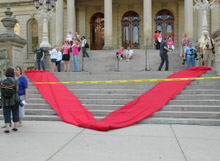
Brown understands her moment, and that the best defense is a great offense. Female liberals understand that when you enrage the opposition, you don't back down; you go further. She staged a reading of "The Vagina Monologues" on the Michigan courthouse steps: 2,500 people, men and women, came to watch Brown, along with an appearance by revered playwright and rape campaigner Eve Ensler. (See this account from Autumn Smith.)
Making the V-sign in Lansing. Photograph: Autumn Smith
Ensler rightly pointed out that the issue is not about the propriety of the word, but about anxieties about women's access to power. Ensler declared, to applause:
"The vaginas are out. We are here to stay."
This battle fascinates me. I had a similar feeling watching a recent news item concerning Carol Price, a former TSA worker, who had experienced, going through security, what she thought was an overly invasive search. She turned to a supervisor and grabbed at the TSA agent's genitals to demonstrate, and was promptly arrested for "assault". This exchange, like the one in Michigan, suddenly snaps one out of the weird collective hypnosis of how "the way things are done" can make you not see the crazy-obvious. The TSA can grab your crotch and it's essential for "national security", but when you grab theirs, it's assault?
Legislators discussing at length and in detail bills dealing with women's vaginas and uteruses, and closely defining a legal range of vaginal options (for example, regarding ultrasound probes) – with outcomes sometimes profoundly against women's will about what should be done to their vaginas – is "legislative decorum"; but the minute a woman utters the word "vagina" or compares to being raped a planned legislative outcome against women's will, all hell breaks loose?
Something worth foregrounding, because it is so often obscured by debate about what happens in the uterus, is that D-and-C's and even later abortions are performed vaginally – that most private of private places, site of the most personal of decisions. What occurs in the Michigan statehouse when legislating on these issues is, therefore, categorically about Brown's vagina. I think Brown used that personal, intimate, confrontational word partly to demonstrate mnemonically how very personal, intimate and, literally, inward or internal the decision to have an abortion really is, and what the action of an abortion really involves.
The "pro-lifers", I have argued before, are entirely within their rights to hold up signs that show images of the fact of a dead fetus. It is a real fact, a real image, not propaganda or spin. But in exactly the same way, Brown is within her rights to shove the word "vagina" and even its image into the public discourse: it is an equally real fact, the real site where the result of all this wilful abstraction, in which the Michigan Republicans have sought to engage, will be played out. From a pro-life perspective, and from many points of view, there is no escape from the outcome being that so-graphic one. But from a pro-choice perspective, and others', too, there is no escape from the site of the abortion being that so-intimate one.
Brown's fight is not new. The 1970s were the high point of feminists waving the vagina flag in the hallowed halls of patriarchy. Indeed, the vagina has been contested linguistic and physical real estate for all of recorded patriarchy. But Brown's invocation – in the context of this new front in the "war on women" of copycat legislation focused on vaginas, similar to Michigan's, rolling out across 22 states – takes the fight to a new level.
The confrontation in Michigan confirms what Ensler makes clear: this is not about a sex organ, or about obscenity. The vagina isn't outrageous when it is under someone else's control, but it immediately becomes outrageous when a woman decides to control its meanings, define the morality and hermeneutics of its experiences – as Brown was doing – and determine its deployment, for herself. This fight beautifully illustrates what is so magical, disruptive and potent about the word "vagina" and vaginal politics.
Brown's was an act of appropriation. When "fags" became "queer" (as in the slogan, "we are here; we are queer"), they became more powerful, claiming that epithet and refusing the stigma and shame society had previously attached to it. Brown did the same thing.
I am not surprised that Brown's flag-waving is unleashing a torrent of female solidarity. This seems to be the year of the vagina; from virginity exams by the Egyptian military of female protesters in Tahrir Square, to the brutal introduction of the punitive transvaginal sonogram, women are being targeted in this age-old way. But what is new is that women are claiming the word, loud and clear. They have stopped running from the slut-shaming that so closely follows it; they have had enough of this kind of control and assault.
Liz Topp, co-author of Vaginas: A Owner's Manual, once described how, when a group of high-school girls realized how they were being disempowered and silenced, both sexually and socially, they asked for space in the school's meeting agenda, and, before the whole student body, stood side by side and shouted, "VAGINA! VAGINA! VAGINA!" They were, in their own way, saying no to the abuse and objectification of women, and taking back what was theirs.
As Lisa Brown and all the Michigan citizens who rallied around her have done.
Written by <a href="index.php?option=com_comprofiler&task=userProfile&user=7181"><span class="small">Glenn Greenwald, Guardian UK</span></a>
Wednesday, 20 June 2012 12:23
Greenwald writes: "Given the travesty that is American justice, WikiLeaks' founder is entitled to seek asylum and well-advised to fear extradition."
WikiLeaks founder Julian Assange has taken refuge in the Ecuadorian Embassy in London. (photo: Finbarr O'Reilly/Reuters)
Julian Assange's Right to Asylum
By Glenn Greenwald, Guardian UK
20 June 12
f one asks current or former WikiLeaks associates what their greatest fear is, almost none cites prosecution by their own country. Most trust their own nation's justice system to recognize that they have committed no crime. The primary fear is being turned over to the US. That is the crucial context for understanding Julian Assange's 16-month fight to avoid extradition to Sweden, a fight that led him to seek asylum, Tuesday, in the London Embassy of Ecuador.
For several reasons, Assange has long feared that the US would be able to coerce Sweden into handing him over far more easily than if he were in Britain. For one, smaller countries such as Sweden are generally more susceptible to American pressure and bullying.
For another, that country has a disturbing history of lawlessly handing over suspects to the US. A 2006 UN ruling found Sweden in violation of the global ban on torture for helping the CIA render two suspected terrorists to Egypt, where they were brutally tortured (both individuals, asylum-seekers in Sweden, were ultimately found to be innocent of any connection to terrorism and received a monetary settlement from the Swedish government).
Perhaps most disturbingly of all, Swedish law permits extreme levels of secrecy in judicial proceedings and oppressive pre-trial conditions, enabling any Swedish-US transactions concerning Assange to be conducted beyond public scrutiny. Ironically, even the US State Department condemned Sweden's "restrictive conditions for prisoners held in pretrial custody", including severe restrictions on their communications with the outside world.
Assange's fear of ending up in the clutches of the US is plainly rational and well-grounded. One need only look at the treatment over the last decade of foreign nationals accused of harming American national security to know that's true; such individuals are still routinely imprisoned for lengthy periods without any charges or due process. Or consider the treatment of Bradley Manning, accused of leaking to WikiLeaks: a formal UN investigation found that his pre-trial conditions of severe solitary confinement were "cruel, inhuman and degrading", and he now faces capital charges of aiding al-Qaida. The Obama administration's unprecedented obsession with persecuting whistleblowers and preventing transparency – what even generally supportive, liberal magazines call "Obama's war on whistleblowers" – makes those concerns all the more valid.
No responsible person should have formed a judgment one way or the other as to whether Assange is guilty of anything in Sweden. He has not even been charged, let alone tried or convicted, of sexual assault, and he is entitled to a presumption of innocence. The accusations made against him are serious ones, and deserve to be taken seriously and accorded a fair and legal resolution.
But the WikiLeaks founder, like everyone else, is fully entitled to invoke all of his legal rights, and it's profoundly reckless and irresponsible to suggest, as some have, that he has done anything wrong by doing so. Seeking asylum on the grounds of claimed human rights violations is a longstanding and well-recognized right in international law. It is unseemly, at best, to insist that he forego his rights in order to herd him as quickly as possible to Sweden.
Assange is not a fugitive and has not fled. Everyone knows where he is. If Ecuador rejects his asylum request, he will be right back in the hands of British authorities, who will presumably extradite him to Sweden without delay. At every step of the process, he has adhered to, rather than violated, the rule of law. His asylum request of yesterday is no exception.
Julian Assange has sparked intense personal animosity, especially in media circles – a revealing irony, given that he has helped to bring about more transparency and generated more newsworthy scoops than all media outlets combined over the last several years. That animosity often leads media commentators to toss aside their professed beliefs and principles out of an eagerness to see him shamed or punished.
But ego clashes and media personality conflicts are pitifully trivial when weighed against what is at stake in this case: both for Assange personally and for the greater cause of transparency. If he's guilty of any crimes in Sweden, he should be held to account. But until then, he has every right to invoke the legal protections available to everyone else. Even more so, as a foreign national accused of harming US national security, he has every reason to want to avoid ending up in the travesty known as the American judicial system.
THE NEW STREAMLINED RSN LOGIN PROCESS: Register once, then login and you are ready to comment. All you need is a Username and a Password of your choosing and you are free to comment whenever you like! Welcome to the Reader Supported News community.



 our years ago, when I was writing about the 2008 presidential campaign,

 n an appearance today on America's Newsroom, Fox News contributor Karl Rove expressed concern that President Obama's assertion of executive privilege over a set of Department of Justice internal documents was a novel expansion of the doctrine. The former senior advisor to President George W. Bush was ill-equipped to make this claim, as Bush invoked the privilege under similar circumstances while Rove was his top political advisor.
 s we gather in our respective bunkers awaiting the white smoke from the

 ou've got to love