RSN Fundraising Banner
FB Share
Email This Page
add comment
Politics
Crowd Control Print
Monday, 17 March 2014 08:20

Lapham writes: "For the last several years, the word 'revolution' has been hanging around backstage on the national television talk-show circuit waiting for somebody, anybody -- visionary poet, unemployed automobile worker, late-night comedian -- to cue its appearance on camera."

Protesters clash with police after gaining new positions near the Independence square in Kyiv on February 20, 2014. (photo: Louisa Gouliamaki/AFP/Getty Images)


Crowd Control

By Lewis H. Lapham, TomDispatch

17 March 14


In case of rain, the revolution will take place in the hall.
-- Erwin Chargaff

or the last several years, the word “revolution” has been hanging around backstage on the national television talk-show circuit waiting for somebody, anybody -- visionary poet, unemployed automobile worker, late-night comedian -- to cue its appearance on camera. I picture the word sitting alone in the green room with the bottled water and a banana, armed with press clippings of its once-upon-a-time star turns in America’s political theater (tie-dyed and brassiere-less on the barricades of the 1960s countercultural insurrection, short-haired and seersucker smug behind the desks of the 1980s Reagan Risorgimento), asking itself why it’s not being brought into the segment between the German and the Japanese car commercials.

Surely even the teleprompter must know that it is the beast in the belly of the news reports, more of them every day in print and en blog, about income inequality, class conflict, the American police state. Why then does nobody have any use for it except in the form of the adjective, revolutionary, unveiling a new cellphone app or a new shade of lipstick?

I can think of several reasons, among them the cautionary tale told by the round-the-clock media footage of dead revolutionaries in Syria, Egypt, and Tunisia, also the certain knowledge that anything anybody says (on camera or off, to a hotel clerk, a Facebook friend, or an ATM) will be monitored for security purposes. Even so, the stockpiling of so much careful silence among people who like to imagine themselves on the same page with Patrick Henry -- “Give me liberty, or give me death” -- raises the question as to what has become of the American spirit of rebellion. Where have all the flowers gone, and what, if anything, is anybody willing to risk in the struggle for “Freedom Now,” “Power to the People,” “Change We Can Believe In”?

My guess is next to nothing that can’t be written off as a business expense or qualified as a tax deduction. Not in America at least, but maybe, with a better publicist and 50% of the foreign rights, somewhere east of the sun or west of the moon.

Revolt from Thomas Jefferson to the Colossal Dynamo

The hallowed American notion of armed rebellion as a civic duty stems from the letter that Thomas Jefferson writes from Paris in 1787 as a further commentary on the new Constitution drawn up that year in Philadelphia, a document that he thinks invests the state with an unnecessary power to declare the citizenry out of order. A mistake, says Jefferson, because no country can preserve its political liberties unless its rulers know that their people preserve the spirit of resistance, and with it ready access to gunpowder.

“The tree of liberty must be refreshed from time to time with the blood of patriots and tyrants. It is its natural manure.”

Jefferson conceived of liberty and despotism as plantings in the soil of politics, products of human cultivation subject to changes in the weather, the difference between them not unlike that between the growing of an orchard and the draining of a cesspool, both understood as means of environmental protection. It is the turning of the seasons and the cyclical motions of the stars that Jefferson has in mind when in his letter he goes on to say, “God forbid we should ever be twenty years without such a rebellion” -- i.e., one conceived not as a lawless upheaval but as a lawful recovery.

The twentieth-century philosopher and political scientist Hannah Arendt says that the American Revolution was intended as a restoration of what its progenitors believed to be a natural order of things “disturbed and violated” by the despotism of an overbearing monarchy and the abuses of its colonial government. During the hundred years prior to the Declaration of Independence, the Americans had developed tools of political management (church congregations, village assemblies, town meetings) with which to govern themselves in accordance with what they took to be the ancient liberties possessed by their fellow Englishmen on the far side of the Atlantic Ocean. They didn’t bear the grievances of a subjugated populace, and the seeds of revolt were nowhere blowing in the wind until the British crown demanded new, and therefore unlawful, tax money.

Arendt’s retrieval of the historical context leads her to say of the war for independence that it was “not revolutionary except by inadvertence.” To sustain the point she calls on Benjamin Franklin’s memory of the years preceding the shots fired at Lexington in April 1775: “I never had heard in any conversation from any person, drunk or sober, the least expression of a wish for a separation, or hint that such a thing would be advantageous to America.” The men who came to power after the Revolution were the same men who held power before the Revolution, their new government grounded in a system of thought that was, in our modern parlance, conservative.

Born 13 years later under the fixed star of a romantic certainty, the French Revolution was advertent, a violent overthrow of what its proponents, among them Maximilien de Robespierre, perceived as an unnatural order of things. Away with the old, in with the new; kill the king, remove the statues, reset the clocks, welcome to a world that never was but soon is yet to come.

The freedom-loving songs and slogans were well suited to the work of ecstatic demolition, but a guillotine is not a living tree, and although manured with the blood of aristocrats and priests, it failed to blossom with the leaves of political liberty. An armed mob of newly baptized citoyens stormed the Bastille in 1789; Napoleon in 1804 crowned himself emperor in the cathedral of Notre Dame.

Jefferson’s thinking had been informed by his study of nature and history, Robespierre’s by his reading of Rousseau’s poetics. Neither set of political ideas brought forth the dream-come-true products of the nineteenth-century Industrial Revolution -- new worlds being born every day of the week, the incoming tide of modern manufacture and invention (the cotton gin, gas lighting, railroads) washing away the sand castles of medieval religion and Renaissance humanism, dismantling Robespierre’s reign of virtue, uprooting Jefferson’s tree of liberty.

So it is left to Karl Marx, along with Friedrich Engels, to acknowledge the arrival of the new world that never was with the publication in German of the Communist Manifesto in 1848: “The bourgeoisie cannot exist without constantly revolutionizing the instruments of production, and thereby the relations of production, and with them the whole relations of society.”

Men shape their tools, their tools shape their relations with other men, and the rain it raineth every day in a perfect storm of creative destruction that is amoral and relentless. The ill wind, according to Marx, blows from any and all points of the political compass with the “single, unconscionable freedom -- free trade,” which resolves “personal worth into exchange value,” substitutes “callous ‘cash payment’” for every other form of human meaning and endeavor, devotes its all-devouring enthusiasms to “naked, shameless, direct, brutal exploitation.”

Over the course of the nineteenth century, the energies of the capitalist dynamic take full and proud possession of the whole of Western society. They become, in Marx’s analysis, the embodiment of “the modern representative state,” armed with the wealth of its always newer and more powerful machines (electricity, photography, the telephone, the automobile) and staffed by executives (i.e., politicians, no matter how labeled) who function as “a committee for managing the common affairs of the whole bourgeoisie.” 

What Marx sees in theory as an insatiable abstraction, the American historian Henry Adams sees as concrete and overwhelming fact. Marx is 17 years dead and the Communist Manifesto a sacred text among the left-wing intelligentsia everywhere in Europe when Adams, his habit of mind as profoundly conservative as that of his great-grandfather, stands in front of a colossal dynamo at the Paris Exposition in 1900 and knows that Prometheus, no longer chained to his ancient rock, bestrides the Earth wearing J.P. Morgan’s top hat and P.T. Barnum’s cloak of as many colors as the traffic will bear. Adams shares with Marx the leaning toward divine revelation:

“To Adams the dynamo became a symbol of infinity. As he grew accustomed to the great gallery of machines, he began to feel the forty-foot dynamos as a moral force, much as the early Christians felt the Cross. The planet itself seemed less impressive, in its old-fashioned, deliberate, annual or daily revolution, than this huge wheel, revolving within arm’s length at some vertiginous speed... Before the end, one began to pray to it; inherited instinct taught the natural expression of man before silent and infinite force.”

The Sixties Swept Away in a Whirlwind of Commodities and Repressive Surveillance

I inherited the instinct as a true-born American bred to the worship of both machinery and money; an appreciation of its force I acquired during a lifetime of reading newspaper reports of political uprisings in the provinces of the bourgeois world state -- in China, Israel, and Greece in the 1940s; in the 1950s those in Hungary, Cuba, Guatemala, Algeria, Egypt, Bolivia, and Iran; in the 1960s in Vietnam, France, America, Ethiopia, and the Congo; in the 1970s and 1980s in El Salvador, Poland, Nicaragua, Kenya, Argentina, Chile, Indonesia, Czechoslovakia, Turkey, Jordan, Cambodia, again in Iran; over the last 24 years in Russia, Venezuela, Lebanon, Croatia, Bosnia, Libya, Tunisia, Syria, Ukraine, Iraq, Somalia, South Africa, Romania, Sudan, again in Algeria and Egypt.

The plot line tends to repeat itself -- first the new flag on the roof of the palace, rapturous crowds in the streets waving banners; then searches, requisitions, massacres, severed heads raised on pikes; soon afterward the transfer of power from one police force to another police force, the latter more repressive than the former (darker uniforms, heavier motorcycles) because more frightened of the social and economic upheavals they can neither foresee nor control.

All the shiftings of political power produced changes within the committees managing regional budgets and social contracts on behalf of the bourgeois imperium. None of them dethroned or defenestrated Adams’ dynamo or threw off the chains of Marx’s cash nexus. That they could possibly do so is the “romantic idea” that Albert Camus, correspondent for the French Resistance newspaper Combat during and after World War II, sees in 1946 as having been “consigned to fantasy by advances in the technology of weaponry.”

The French philosopher Simone Weil draws a corollary lesson from her acquaintance with the Civil War in Spain, and from her study of the communist Sturm und Drang in Russia, Germany, and France subsequent to World War I. “One magic word today seems capable of compensating for all sufferings, resolving all anxieties, avenging the past, curing present ills, summing up all future possibilities: that word is revolution... This word has aroused such pure acts of devotion, has repeatedly caused such generous blood to be shed, has constituted for so many unfortunates the only source of courage for living, that it is almost a sacrilege to investigate it; all this, however, does not prevent it from possibly being meaningless.”

During the turbulent decade of the 1960s in the United States, the advancing technologies of bourgeois news production (pictures in place of print) transformed the meaningless magic word into a profitable commodity, marketing it both as deadly menace and lively fashion statement. The commercial putsch wasn’t organized by the CIA or planned by a consortium of advertising agencies; it evolved in two stages as a function of the capitalist dynamic that substitutes cash payment for every other form of human meaning and endeavor.

The disorderly citizenry furnishing the television footage in the early sixties didn’t wish to overthrow the government of the United States. Nobody was threatening to reset the game clock in the Rose Bowl, tear down Grand Central Terminal, or remove the Lincoln Memorial. The men, women, and children confronting racist tyranny in the American South -- sitting at a lunch counter in Alabama, riding a bus into Mississippi, going to school in Arkansas -- risked their lives in pure acts of devotion, refreshing the tree of liberty with the blood of patriots.

The Civil Rights movement and later the anti-Vietnam War protests were reformative, not revolutionary, the expression of democratic objection and dissent in accord with the thinking of Jefferson, also with President John F. Kennedy’s having said in his 1961 inaugural address, “Ask not what your country can do for you -- ask what you can do for your country.” Performed as a civic duty, the unarmed rebellions led to the enactment in the mid-1960s of the Economic Opportunity Act, the Voting Rights Act, the Medicare and Medicaid programs, eventually to the shutting down of the war in Vietnam.

The television camera, however, isn’t much interested in political reform (slow, tedious, and unphotogenic) and so, even in the first years of protest, the news media presented the trouble running around loose in the streets as a revolution along the lines of the one envisioned by Robespierre. Caught in the chains of the cash nexus, they couldn’t do otherwise. The fantasy of armed revolt sold papers, boosted ratings, monetized the fears at all times running around loose in the heads of the propertied classes.

The multiple wounds in the body politic over the course of the decade -- the assassination of President Kennedy, big-city race riots, student riots at venerable universities, the assassinations of Dr. Martin Luther King Jr. and Senator Robert F. Kennedy -- amplified the states of public alarm. The fantastic fears of violent revolt awakened by a news media in search of a profit stimulated the demand for repressive surveillance and heavy law enforcement that over the last 50 years has blossomed into one of the richest and most innovative of the nation’s growth industries. For our own good, of course, and without forgoing our constitutional right to shop.

God forbid that the excitement of the 1960s should in any way have interfered with the constant revolutionizing of the bourgeois desire for more dream-come-true products to consume and possess. The advancing power of the media solved what might have become a problem by disarming the notion of revolution as a public good, rebranding it as a private good. Again it was impossible for the technology to do otherwise.

The medium is the message, and because the camera sees but doesn’t think, it substitutes the personal for the impersonal; whether in Hollywood restaurants or Washington committee rooms, the actor takes precedence over the act. What is wanted is a flow of emotion, not a train of thought, a vocabulary of images better suited to the selling of a product than to the expression of an idea. Narrative becomes montage, and as commodities acquire the property of information, the amassment of wealth follows from the naming of things rather than the making of things.

The voices of conscience in the early 1960s spoke up for a government of laws, not men, for a principle as opposed to a lifestyle. By the late 1960s the political had become personal, the personal political, and it was no longer necessary to ask what one must do for one’s country. The new-and-improved question, available in a wide range of colors, flower arrangements, cosmetics, and musical accompaniments, underwrote the second-stage commodification of the troubled spirit of the times.

Writing about the socialist turbulence on the late-1930s European left, Weil lists among the acolytes of the magic word, “the bourgeois adolescent in rebellion against home surroundings and school routine, the intellectual yearning for adventure and suffering from boredom.” So again in America in the late 1960s, radical debutantes wearing miniskirts and ammunition belts, Ivy League professors mounting the steps of the Pentagon, self-absorbed movie actors handing around anarchist manifestos to self-important journalists seated at the tables in Elaine’s.

By the autumn of 1968 the restaurant on the Upper East Side of Manhattan served as a Station of the Cross for the would-be revolutionaries briefly in town for an interview with Time or a photo shoot for Vogue, and as a frequent guest of the restaurant, I could see on nearly any night of the week the birth of a new and imaginary self soon to become a boldfaced name. Every now and then I asked one of the wandering stars what it was that he or she hoped to have and to hold once the revolution was won. Most of them were at a loss for an answer. What they knew, they did not want, what they wanted, they did not know, except, of course, more -- more life, more love, more drugs, more celebrity, more happiness, more music.

On Becoming an Armed Circus

As a consequence of the political becoming personal, by the time the 1960s moved on to the 1980s and President Reagan’s Morning in America, it was no longer possible to know oneself as an American citizen without the further identification of at least one value-adding, consumer-privileged adjective -- female American, rich American, black American, Native American, old American, poor American, gay American, white American, dead American. The costumes changed, and so did the dossier of the malcontents believing themselves entitled to more than they already had.

A generation of dissatisfied bourgeois reluctant to grow up gave way to another generation of dissatisfied bourgeois unwilling to grow old. The locus of the earthly Paradise shifted from a commune in the White Mountains to a gated golf resort in Palm Springs, and the fond hope of finding oneself transformed into an artist segued into the determined effort to make oneself rich. What remained constant was the policy of enlightened selfishness and the signature bourgeois passion for more plums in the pudding.

While making a magical mystery tour of the Central American revolutionary scene in 1987, Deb Olin Unferth remarks on the work in progress: “Compared to El Salvador, Nicaragua was like Ping-Pong... like a cheerful communist kazoo concert... We were bringing guitars, plays adapted from Nikolai Gogol, elephants wearing tasseled hats. I saw it myself and even then I found it a bit odd. The Nicaraguans wanted land, literacy, a decent doctor. We wanted a nice singalong and a ballet. We weren’t a revolution. We were an armed circus.”

As a descriptive phrase for what American society has become over the course of the last five decades, armed circus is as good as any and better than most. The constantly revolutionizing technologies have been spinning the huge bourgeois wheel of fortune at the speed of light, remaking the means of production in every field of human meaning and endeavor -- media, manufacturing, war, finance, literature, crime, medicine, art, transport, and agriculture.

The storm wind of creative destruction it bloweth every day, removing steel mills, relocating labor markets, clearing the ground for cloud storage. On both sides of the balance sheet, the accumulations of more -- more microbreweries and Internet connections, more golf balls, cheeseburgers, and cruise missiles; also more unemployment, more pollution, more obesity, more dysfunctional government and criminal finance, more fear. The too much of more than anybody knows what to do with obliges the impresarios of the armed circus to match the gains of personal liberty (sexual, social, economic, if one can afford the going price) with more repressive systems of crowd control.

To look back to the early 1960s is to recall a society in many ways more open and free than it has since become, when a pair of blue jeans didn’t come with a radio-frequency ID tag, when it was possible to appear for a job interview without a urine sample, to say in public what is now best said not at all. So frightened of its own citizens that it classifies them as probable enemies, the U.S. government steps up its scrutiny of what it chooses to regard as a mob. So intrusive is the surveillance that nobody leaves home without it. Tens of thousands of cameras installed in the lobbies of office and apartment buildings and in the eye sockets of the mannequins in department-store windows register the comings and goings of a citizenry deemed unfit to mind its own business.

The social contract offered by the managing agents of the bourgeois state doesn’t extend the privilege of political revolt, a point remarked upon by the Czech playwright Václav Havel just prior to being imprisoned in the late 1970s by the Soviet regime then governing Czechoslovakia: “No attempt at revolt could ever hope to set up even a minimum of resonance in the rest of society, because that society is ‘soporific,’ submerged in a consumer rat race... Even if revolt were possible, however, it would remain the solitary gesture of a few isolated individuals, and they would be opposed not only by a gigantic apparatus of national (and supranational) power, but also by the very society in whose name they were mounting their revolt in the first place.”

The observation accounts for the past sell-by date of the celebrity guest alone and palely loitering in the green room with the bottled water and the banana. Who has time to think or care about political change when it’s more than enough trouble to save oneself from drowning in the flood of technological change? All is not lost, however, for the magic word that stormed the Bastille and marched on the tsar’s winter palace; let it give up its career as a noun, and as an adjective it can look forward to no end of on-camera promotional appearances with an up-and-coming surgical procedure, breakfast cereal, or video game.


e-max.it: your social media marketing partner
 
Why We Need a New Church Committee to Fix Our Broken Intelligence System Print
Monday, 17 March 2014 08:18

Schwarz writes: "Almost forty years ago, a Senate select committee known as the Church Committee for its chair, Idaho Senator Frank Church, investigated America's secret government."

 (photo: Reuters/Larry Downing)
(photo: Reuters/Larry Downing)


Why We Need a New Church Committee to Fix Our Broken Intelligence System

By Frederick A.O. Schwarz Jr., The Nation

17 March 14


As Senator Feinstein has revealed, the CIA will not only stall but even spy on Congress to impede its investigation of wrongdoing.

lmost forty years ago, a Senate select committee known as the Church Committee for its chair, Idaho Senator Frank Church, investigated America’s secret government. The committee’s investigation remains the most extensive of its kind in this nation’s history. Now it is time for a new committee to examine our secret government closely again, particularly for its actions in the post-9/11 period.

This need is underscored by what has become a full-blown crisis, with Senate Intelligence Committee chair Dianne Feinstein accusing the CIA of spying on the committee, possibly violating the Constitution’s separation-of-powers principles, the Fourth Amendment and other laws.

The Church Committee uncovered shocking conduct by numerous agencies, including the FBI, CIA and NSA. For example, the FBI tried to get Martin Luther King Jr. to commit suicide; the CIA enlisted the Mafia in its attempts to assassinate Fidel Castro; and the NSA and its predecessor, the Armed Forces Security Agency, obtained copies of most telegrams leaving America for a period of thirty years. An agency little known then but these days at the center of the news, the NSA’s example provides an urgent warning. Its original aim was to decode encrypted telegrams sent home by foreign ambassadors. But then, exemplifying the “mission creep” that the Church Committee found endemic, the NSA trained its sights on anti–Vietnam War protesters and civil rights activists.

Many expected the Church Committee to focus its attention on exposing the abuses of the Nixon administration. But the committee’s most important finding was that every administration from FDR’s through Nixon’s—four Democrats and two Republicans—had abused its secret powers. This finding helped the committee’s internal cohesion and external impact.

The ability now to look into the post-9/11 secret programs conducted under administrations from both parties should add to the impetus to form a new committee. Several years ago, I testified before Congress in favor of creating a committee to investigate post-9/11 practices like secret torture and warrantless wiretapping. But an investigation then would have focused only on the Bush/Cheney administration, making partisan splits more likely. This was probably one reason that Barack Obama opposed such an investigation, indicating that he wanted to look forward rather than back. At the time, Senate Judiciary Committee chair Patrick Leahy quipped that “we need to be able to read the page before we turn it,” but Obama prevailed.

Now the revelations by Edward Snowden confirm that a new investigation would have to cover more than one administration. Today’s world of terror threats is different from the Cold War world that existed in the Church Committee’s day. Today’s technology is also vastly different. But those differences only add to the need for a new and comprehensive nonpartisan investigation.

As a result of the Church Committee, two institutions were created to check the enormous powers of our secret government: intelligence committees in both houses of Congress, and the court established under the Foreign Intelligence Surveillance Act. Over time, each has become a less reliable check. In addition, courts have bent over backwards to accept “state secrecy” claims by the Bush and Obama administrations. The same is true in Freedom of Information Act cases. On the other hand, some checks, including agency inspectors general, are stronger than before.

In addition to nonpartisanship, what is needed to ensure the success of a new select committee? To start with, it must be resolute in getting the facts, in pressing for government documents and witnesses. Executive agencies and the White House—whichever party is in power—will always resist such efforts. They will stall, they will rely on secrecy, and—if Feinstein is right—they may even spy on Congress and illegally impede its lawful investigations. These obstructions must be overcome.

On the other hand, a successful investigation must show that it can handle secrets responsibly. Two agreements made by the Church Committee in the ’70s could also be implemented today. First, when documents are produced, an agency can redact the names of its informers (in, for example, the NAACP); then, if committee members need those names, they can press for them. Second, the White House and federal agencies can be permitted to see the draft reports and argue that certain details are unnecessary and harmful. One reason the Church Committee succeeded and the parallel House investigation failed was that the House was unwilling to make such agreements. It also leaked like a sieve, while the Church Committee had no substantive leaks.

A new select committee on intelligence must also be resolute on its right to disagree with the agencies concerning secrecy and to make the final decisions on disclosure—as the Church Committee did, for example, when it rejected White House and agency objections to disclosing the names of companies that gave telegrams to the NSA, as well as the names of higher-level officials involved in the plots to kill Castro and other foreign leaders.

Also, a committee cannot let an agency use its opportunity for comment to stall a report’s release, as has happened recently with respect to the investigation of torture by the Senate Intelligence Committee. We now know that John Yoo’s legal defense was embarrassingly wrong. Torture—or, as the Bush/Cheney administration euphemistically called it, “enhanced interrogation”—is illegal. The US government used techniques, like waterboarding, for which we had prosecuted Japanese officials as war criminals after World War II. President Obama found the program illegal and renounced it. Still, many officials—including Dick Cheney and some in the CIA—claim that “enhanced interrogation” was effective in protecting Americans.

This issue is apparently explored in the Senate Intelligence Committee’s 6,300-page draft report, to which the CIA made a 122-page rebuttal in June 2013. The underlying documents remain classified, stalling the report’s release. But after considering the CIA’s rebuttal and any specific classification concerns, the committee should do exactly as Feinstein urges and release its report. Surely legitimate classification no longer applies to “enhanced interrogation.”

But according to recent investigative articles in The New York Times, there is now a collateral issue. It turns out that, as Feinstein points out, an internal CIA study reached many of the same conclusions that the committee did: the methods were not effective, and CIA officials misled the government by claiming they were. In other words, the CIA’s study, known as the “Internal Panetta Review,” contradicts the agency’s June rebuttal. The committee has that study. The CIA wants to investigate the committee’s staff for obtaining it, claiming executive privilege and arguing that the agency did not produce it in response to the committee’s document demands. But any executive privilege claim against the committee is weak, and the Panetta Review, as Feinstein insists, falls within the committee’s demand for all documents concerning “enhanced interrogation.” President Obama should end the CIA’s stalling, and the committee should issue its report, including the information in the CIA’s own study. To do otherwise undermines necessary committee oversight.

In order to propose future guidance, any investigation must expose past wrongdoing and mistakes. To do so, it has to say what individuals have done and make judgments on their responsibility. But a committee is neither a prosecutor nor a court. Accordingly, in 1976 the Church Committee expressed hope that its reports “will provoke a national debate not on ‘Who did it?’, but on ‘How did it happen and what can be done to keep it from happening again?’” In that spirit, fairness requires recognition that most officials who broke our laws, undermined our values and sullied our traditions thought they were acting to protect us from grave threats. But a new investigation should nonetheless expose what happened and assess the damage. If it does so, then the words of Republican Senator Howard Baker in assessing the Church Committee’s impact should prove correct. While dealing with the short-term effects may be hard, Baker said, “a responsible inquiry, as this has been, will, in the long run, result in a stronger and more efficient intelligence community.” Particularly when the government’s technological powers have become so awesome, the country needs a new nonpartisan, fact-based and comprehensive investigation of our secret government.


e-max.it: your social media marketing partner
 
David Brooks, The Last Romantic Print
Written by <a href="index.php?option=com_comprofiler&task=userProfile&user=11104"><span class="small">Charles Pierce, Esquire</span></a>   
Sunday, 16 March 2014 14:56

Pierce writes: "No, really, David, it's nice to see you again. Thanks for coming. Stay right here. Have some dip. I have to go into the kitchen and saute the cat."

David Brooks. (photo: unknown)


David Brooks, The Last Romantic

By Charles Pierce, Esquire

16 March 14


ear god, someone get this man a cookie.

Women, meanwhile, have different tastes at different times in their cycles. During ovulation, according to some research, they prefer ruggedly handsome and risky men, while at other times they are more drawn to pleasant-looking, nice men. When men look at pictures of naked women, their startle response to loud noises diminishes. It seems that the dopamine surge mutes the prefrontal cortex, and they become less alert to danger and risk.

Don't read Penthouse while crossing the street, ya stupid bastid.

We originate with certain biological predispositions. These can include erotic predispositions (we're aroused by people who send off fertility or status cues), or they can be cognitive (like loss aversion). But depth, the core of our being, is something we cultivate over time. We form relationships that either turn the core piece of ourselves into something more stable and disciplined or something more fragmented and disorderly. We begin with our natural biases but carve out depths according to the quality of the commitments we make. Our origins are natural; our depths are man-made - engraved by thought and action.

No, really, David, it's nice to see you again. Thanks for coming. Stay right here. Have some dip. I have to go into the kitchen and saute the cat.

David Brooks. The Last Romantic.

Also available for kid's parties.


e-max.it: your social media marketing partner
 
We Have Not Consented to Our Own Constant Surveillance Print
Sunday, 16 March 2014 14:54

Lennard writes: "One photo from the sometime halcyon days of Occupy Wall Street has come to haunt me."

 (photo: AP/Julio Cortez)
(photo: AP/Julio Cortez)


We Have Not Consented to Our Own Constant Surveillance

By Natasha Lennard, The New Inquiry

16 March 14


We have not consented to our own constant surveillance, even if the way we live has produced it.

ne photo from the sometime halcyon days of Occupy Wall Street has come to haunt me. The image, which was used as the cover for the second issue of Tidal, Occupy’s theory journal, at first glance seems to capture a trenchant insurrectionary tableau. A massive mob of protesters appears on the cusp of breaking down a fence, held up by a measly line of riot cops defending the emptiness of Duarte Square, a drab expanse of concrete in downtown Manhattan. Look closer, though, and a different scene comes in to focus: No more than a scattered handful of protesters are actually pushing against the fence. The rest of the crowd, pressed tight against each other, hold smartphones aloft, recording each other recording each other for the (assumed) viewers at home. The fence of Duarte Square was barely breached that December day.

Over two years later, and nine months since Edward Snowden’s NSA leaks have highlighted totalized -surveillance as an undeniable fact of the American now, one wonders whether such an image of mutual co-surveillance would make it onto the cover of a self-identifying radical magazine.

For me, the photo captures the problematic, near knee-jerk proclivity many participants had to live-recount every action over smartphones, with the idea that this was inherently bold and radical, taking the narrative of protest into our own hands, our own broadcast devices, refusing reliance on media institutions. Regardless of where you stand on the question of whether social-media platforms like Twitter have helped, hindered, or shaped recent protest, the Tidal cover image carries a different valence in light of the Snowden revelations. The smartphones in that photograph were not only a hindrance to the crowd’s purported effort to swarm Duarte Square; they were, of course, surveillance devices too. The photo’s caption could well read: Unwitting footsoldiers of the surveillance state watch each other for the state.

In that image—where a desire for insurrectionary freedom is paired with advanced technocapitalism’s ­surveillance-control apparatus—our current problem is crystallized. The devices we rely upon to communicate and gather information and build the solidarity necessary for contemporary protests also offer us up as ripe for constant surveillance. The surveillance state could not be upheld without its always already trackable denizens. To sidestep our tacit complicity in this would be to fail to recognize how deep it runs—it’s how we live. As my Salon colleague Andrew Leonard noted, “In 2013, the negative consequences of our contemporary lifestyles were impossible to ignore.”

But to assert our consent to this circumstance, however, would be unfair—in many ways, we have no choice. The problem of our complicity and consent in a state of totalized surveillance is intractable. But that doesn’t mean we should ignore it.

Revelations about mass corporate-government spying have given rise to a peculiar sort of popular crisis. Who is to blame? Where are the bad guys? How do we fight back? Popular outrage following the NSA revelations has sought an object, a vessel, a villain. Be it Director of National Intelligence James Clapper, NSA director Keith Alexander, Google, or the PRISM program, we look to blame something we can isolate and locate. But efforts centered on top-down NSA reform and demands for tech giants to be more transparent have largely missed the nuance and gravity of what’s at stake.

Bipartisan lawmaker cohorts have demanded an end to the NSA’s bulk collection of Americans’ communications data; the preposterously named USA Freedom Act is gaining traction primarily on this point. The White House assembled advisory committees who duly issued lengthy reports and promised more reviews to come. The president gave a speech about reform straight out of the POTUS handbook, immediately enacting minute policy change to earn public “confidence,” while leaving the underlying state of totalized surveillance structurally unchanged. Perhaps worst of all, scrambling for position as the “good guys,” tech leviathans including Google and Facebook have pushed for greater transparency. Google’s old, informal slogan “Don’t Be Evil” would more ­appropriately read “Be Evil, But Be Transparent About It.”

The boldest executive and legislative reform even notionally on the table would see dragnet hoarding of our communications moved into the hands of telecom firms, or some sort of private third party, but in NSA-­surveillable form. The specifics of where these databases would be stored if taken out of NSA hands is not yet clear. But one thing is certain: All communications would remain available for government perusal. Reformers rightly want state spy agencies to provide at least some grounds for suspicion before gaining direct access to phone and online communications records, but what those grounds might be is troublingly unclear (and would likely remain as opaque to the public as the operations of national security tend to be). And to be sure, the corporate-government surveillance nexus is going nowhere—the best these reform efforts have to offer is a surveillance state with mildly different contours.

By focusing on legible seats of power, activist groups and outraged political players have largely sidestepped the question of how surveilled subjects uphold—cannot but uphold—their position as surveilled. It is perhaps unbearable to consider that modes of surveillance undergird the way we live in contemporary capitalism. A state of totalized surveillance serves government interests (in social control) and corporate interests (in an enumerated and trackable populace). And it has become a significant source of growth and value within it. But we who use and rely on the devices that render us ripe, surveillable subjects are trapped by the autonomy they also promise us. As poet George Oppen put it, “We have chosen the meaning / Of being numerous”—amassing as individuated, traceable nodes in a network.

The story of this epoch of surveillance is in some ways a formal tragedy, in which those who came of age in the tech boom star as a hydra-headed tragic hero. True to form, the tragic hero was brought down by hubris—our blind embrace of technology, too impressed with our own savvy to see the social control.

A troubling anecdote picked from Snowden’s document trove tells this story as synecdoche. An unnamed NSA analyst produced a smirking slide show for fellow agents about social control and Apple users. One slide recalls the famed 1984 Super Bowl commercial from Apple, announcing the birth of the first personal computer. In the ad, seated, uniformed gray men sit in regimented rows as an Orwellian Big Brother character booms at them through a huge screen overhead. But then, an athletic women in bright orange minishorts bounds forward, evading the grasp of riot police, to swing a sledgehammer into the screen, smashing Big Brother’s visage and freeing his enthralled subjects. “Apple Computer will introduce Macintosh. And you’ll see why 1984 won’t be like 1984,” the ad proclaimed.

The next NSA slide projected a photo of Steve Jobs some 30 years later, with the accompanying text: “Who knew in 1984 … that this would be big brother … and the zombies would be paying customers?” And the NSA agent was correct: We didn’t need an Orwellian Big Brother. Political management, as Foucault had well predicted, would manifest instead through “tiny, everyday, physical mechanisms … systems of micro-power” that produce and are reproduced by “docile bodies.” While providing an unending font of content, information and opportunity for communication, the apparatuses of technocapitalism at the same time produce docility by reproducing users as networked subjects—a tracked, countable, individuated populace that, by virtue of these qualities, upholds conformity.

While we are unquestionably active participants in upholding a surveillance state, to suggest that we are therefore consenting would be to overstate our choice in the matter. Though we are not all inherently reliant, as a point of economic necessity, on surveillance-enabling devices and interfaces, participation in a surveillance state is inescapable for those who abide by the social and economic spirit of the now, because the networks and interfaces born of the tech boom have become the stage on which the social and commercial—even the political and the revolutionary—is enacted in contemporary capitalism.

Our engagement with the devices of the surveillance state goes deeper than the technological tools we use—­indeed these are not simply tools, but apparatuses. In “What Is an Apparatus?” (2009) Italian philosopher Giorgio ­Agamben argues that “ever since Homo sapiens first appeared, there have been apparatuses, but we could say that today there is not even a single instant in which the life of individuals is not modeled, contaminated, or controlled by some apparatus.” For Agamben, an apparatus is not simply a technological device, but “literally anything that has in some way the capacity to capture, orient, determine, intercept, model, control, or secure the gestures, behaviors, opinions, or discourses of living beings.” As such, a language is an apparatus as much as an iPhone. He writes of his “implacable hatred” for cell phones and his desire to destroy them all and punish their users. But then he notes that this is not the right solution. The “apparatus” can not just be isolated in the device, say the smartphone, because apparatuses are shaped by and shape the subjects that use them. Destroying the apparatus would entail destroying in some ways the subjects that create and are in turn created by it.

A mass Luddite movement to smash all smartphones, laptops, GPS devices, and so on would ignore the fact that it is no mere accident of history that millions of us have chosen to live with and through these devices. These ­devices require and in turn produce trackable, numerable and, therefore, surveillable subjects. As such, technocapitalism is a situation in which the question of whether surveilled subjects consent to their own surveillance is moot.

Which is not to say that anger should not be directed at the corporate-government subterfuge that has undergirded the post-9/11 development of vast spy dragnets. Quite evidently, we did not consent to these bulk collections by government agencies; we didn’t even know about the programs. Just this month, the beleaguered James Clapper admitted that the NSA should have been more open with the public about the ubiquitous hoarding of their communications. “If the program had been publicly introduced in the wake of the 9/11 attacks, most Americans would probably have supported it,” he said. But Clapper cannot help but resort to a perverse conditional logic in which the public would have consented to what they could not, in fact, consent to. Clapper’s post hoc assertion that the public would have agreed to mass government surveillance, had they been given advanced warning, is untestable—we can’t go back to that moment. As Ben Wizner, legal adviser to Snowden and the director of the American Civil Liberties Union’s Speech, Privacy and Technology Project commented in response to Clapper, “Whether we would have consented to that at the time will never be known.” We have not consented to our own constant surveillance, even if the way we live has produced it.

The spy chief’s remark truly reflects the issue at hand: We only become aware of the notion that we might have consented or refused to do so in the past tense, when surveillance technologies are so tightly sewn into—and give shape—to the fabric of daily life. The state, in its rhetoric at least, has thus de facto solved the problem of consent when it comes to surveillance: not because consent has been expressly or tacitly given, but because it has been mooted as a fulcrum. The challenge, then, given our hopes and our hubris, is to experiment with whether we can live together, as numerous, without the inescapable fact of being enumerated.


e-max.it: your social media marketing partner
 
How the Missing Malaysia Airlines Jet Could Have Been Hijacked Print
Sunday, 16 March 2014 14:52

Koerner writes: "In the hours after Malaysia Airlines Flight 370 vanished, the notion that hijackers were responsible seemed far-fetched."

 (photo: Rahman Roslan/Getty Images)
(photo: Rahman Roslan/Getty Images)


How the Missing Malaysia Airlines Jet Could Have Been Hijacked

By Brendan I. Koerner, Wired Magazine

16 March 14


n the hours after Malaysia Airlines Flight 370 vanished, the notion that hijackers were responsible seemed far-fetched. Since the 9/11 attacks, commercial pilots have been trained to prevent the weaponization of their planes by never unlocking their cockpit doors for hijackers–even if the lives of passengers are being threatened. Even if the MH370 captain or first officer broke with official policy and opened the door, why wouldn’t one of them first use the jet’s transponder to squawk “7500,” the universal code for a hijacking in progress?

Another possibility was that a crew member was the culprit, much like the Ethiopian Airlines pilot who recently diverted his Boeing 767 to Geneva in search of political asylum. But assuming the motive in such a caper would be escape to a foreign land, the pilot-turned-hijacker would have no clear reason to shut down the plane’s communications systems; doing so would vastly complicate his journey. Early on, then, the smart money was on the disappearance being the result of a catastrophic mechanical failure had caused the plane to plummet from the sky, and that it was only a matter of time before bits of wreckage started to wash ashore.

In recent days, however, several telling snippets of information have emerged that make a hijacking harder to rule out. As the Wall Street Journal first reported, the Boeing 777-200ER’s Rolls-Royce engines appear to have kept transmitting maintenance data for five hours after the jet’s transponder went dead. Reuters later added that military radar had tracked the flight as it seemed to head for the Andaman Islands. Most intriguingly, there are indications the plane’s transponder and data-reporting system were switched off at different times, which, if true, provide solid evidence that a human hand was involved in silencing the aircraft.

With the hijacking theory growing more plausible by the hour, it’s time to wonder how such an epic crime might have occurred–and how it might have ended far more tragically than its perpetrator envisioned.

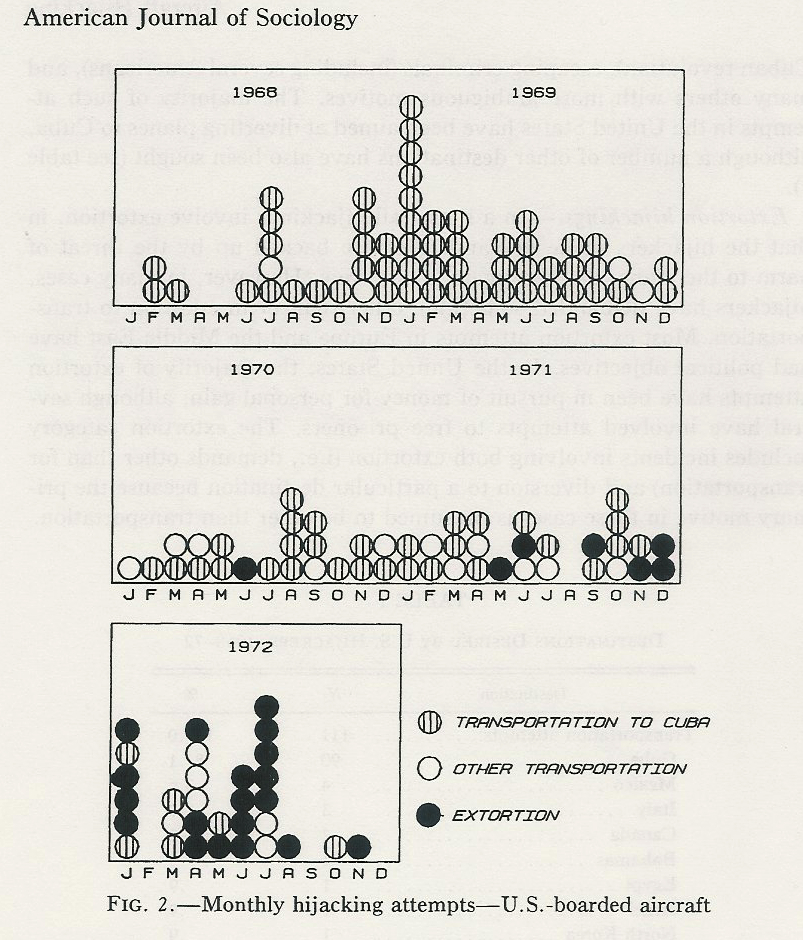
If MH370 was seized by passengers or a crew member, the hijacking would the third so far this year—in addition to the Ethiopian Airlines episode, there also was the bizarre Pegasus Airlines incident of early February, in which an apparently intoxicated Ukrainian man demanded passage to Sochi but was instead taken to Istanbul. This clustering of hijackings shouldn’t be surprising. The crime always has been highly viral in nature; each hijacking tends to be influenced by the last, in terms of modus operandi or other key details. A perfect example of this phenomenon is how “parajacking”–hijackings in which the criminal flees by jumping out of the plane–evolved in the early 1970s. Though most folks only remember the infamous D.B. Cooper hijacking of November 1971, there were numerous other incidents in the ensuing months in which the hijackers became increasingly more adept at getting away from the authorities–at least for a few days. (Cooper himself may have been a copycat, inspired by a farcical Air Canada hijacking.) Perhaps one of MH370’s pilots had been inspired by the Ethiopian Airlines hijacking, and thought he could fly his way to a better life on distant shores.

It also is important to remember that, unlike the highly organized 9/11 terrorists, most hijackers through history have been scatterbrained, sometimes to a comic degree. In the midst of manic episodes or afflicted by paranoia, they often can be quite good at planning minor details of their crimes, yet quite deluded about how the endgames will play out. This certainly was the case with Roger Holder, the principal hijacker of Western Airlines Flight 701 in June 1972. An Army veteran who had served four tours in Vietnam, Holder cooked up a clever ruse by which he convinced the crew that he was accompanied by four members of the Weathermen, at least one of whom was armed with a bomb. But he also hijacked a short-range Boeing 727 by accident, thereby making it impossible for him to reach his intended destination of Hanoi.

If MH370’s hijacker was in a mental state similar to Holder’s, he or she might have had the psychological wherewithal to figure out how to disable the plane’s communications systems, but not to realize that reaching, say, Western Europe was not a feasible goal. The hijacking could even have been an impulsive act, as many such crimes were during America’s “golden age” or air piracy. Ricardo Chavez Ortiz, for example, who commandeered a Frontier Airlines jet in order to get a radio crew to broadcast his rambling 34-minute speech, claimed to have decided to hijack the plane only after it reached cruising altitude.

Though data points may be accumulating in favor of the hijacking theory, it remains difficult to believe that MH370 is now in the possession of a global terror network that plans to use it in a future attack; landing and hiding a Boeing 777-200ER–a 209-foot-long aircraft with a 200-foot wingspan–in a lawless corner of the world would require immense resources, not to mention luck. In fact, there’s a good chance that any hijacker of the flight was not motivated by any sort of radical ideology, but rather by personal woes. In the history of air piracy, the vast majority of hijackers have been men or women who, though they may have claimed political affiliations, were most interested in fleeing from desperate circumstances: economic hardships, legal entanglements, love affairs gone wrong. In the era before everyone had to pass through metal detectors and have their carry-on luggage screened, hijacking a plane was an easy and spectacular way to try and alter one’s fortunes. One young American hijacker, who tried to flee to Cuba with her boyfriend in the late 1960s, neatly summed up that mindset when later asked why she had opted for such a risky crime: “Something had to be done–and I did something, for better or worse. It [was] better than eighteen years of therapy, or whatever. It just seemed like the answer.”

On one level, it’s comforting to think that a hijacker of MH370 was not bent on using the plane as a weapon of mass destruction, but rather wanted to start life anew somewhere else. But it’s also frightening to imagine a world where, as in the early 1970s, the desperate and deluded increasingly start to view hijacking as a reasonable solution to their problems.


e-max.it: your social media marketing partner
 
<< Start < Prev 2931 2932 2933 2934 2935 2936 2937 2938 2939 2940 Next > End >>

Page 2937 of 3432

THE NEW STREAMLINED RSN LOGIN PROCESS: Register once, then login and you are ready to comment. All you need is a Username and a Password of your choosing and you are free to comment whenever you like! Welcome to the Reader Supported News community.

RSNRSN