|
The US Government Doesn't Want You to Know How the Cops Are Tracking You |
 |
|
Written by <a href="index.php?option=com_comprofiler&task=userProfile&user=29990"><span class="small">Trevor Timm, Guardian UK</span></a>
|
|
Saturday, 14 June 2014 14:27 |
|
Timm writes: "All across America, from Florida to Colorado and back again, the country's increasingly militarized local police forces are using a secretive technology to vacuum up cellphone data from entire neighborhoods - including from people inside their own homes - almost always without a warrant."

Local police and the Obama administration are hoovering cellphone location data from inside your house. (photo: Thinkstock)

The US Government Doesn't Want You to Know How the Cops Are Tracking You
By Trevor Timm, Guardian UK
14 June 14
The US Government Doesn't Want You to Know How the Cops are Tracking You
 ll across America, from Florida to Colorado and back again, the country's increasingly militarized local police forces are using a secretive technology to vacuum up cellphone data from entire neighborhoods – including from people inside their own homes – almost always without a warrant. This week, numerous investigations by major news agencies revealed the US government is now taking unbelievable measures to make sure you never find out about it. But a landmark court ruling for privacy could soon force the cops to stop, even as the Obama administration fights to keep its latest tool for mass surveillance a secret. ll across America, from Florida to Colorado and back again, the country's increasingly militarized local police forces are using a secretive technology to vacuum up cellphone data from entire neighborhoods – including from people inside their own homes – almost always without a warrant. This week, numerous investigations by major news agencies revealed the US government is now taking unbelievable measures to make sure you never find out about it. But a landmark court ruling for privacy could soon force the cops to stop, even as the Obama administration fights to keep its latest tool for mass surveillance a secret.
So-called International Mobile Subscriber Identity (IMSI) catchers – more often called their popular brand name, "Stingray" – have long been the talk of the civil liberties crowd, for the indiscriminate and invasive way these roving devices conduct surveillance. Essentially, Stingrays act as fake cellphone towers (usually mounted in a mobile police truck) that police can point toward any given area and force every phone in the area to connect to it. So even if you're not making a call, police can find out who you've been calling, and for how long, as well as your precise location. As Nathan Freed Wessler of the ACLU explained on Thursday, "In one Florida case, a police officer explained in court that he 'quite literally stood in front of every door and window' with his stingray to track the phones inside a large apartment complex."
Yet these mass surveillance devices have largely stayed out of the public eye, thanks to the federal government and local police refusing to disclose they're using them in the first place – sometimes, shockingly, even to judges. As the Associated Press reported this week, the Obama administration has been telling local cops to keep information on Stingrays secret from members of the news media, even when it seems like local public records laws would mandate their disclosure. The AP noted:
Federal involvement in local open records proceedings is unusual. It comes at a time when President Barack Obama has said he welcomes a debate on government surveillance and called for more transparency about spying in the wake of disclosures about classified federal surveillance programs.
Some of the government's tactics to hide Stingray from journalists and the public have been downright disturbing. After the ACLU had filed a records request for information on Stingrays, the local police force initially told them that, yes, they had the documents and to come on down to the station to look at them. But just before an ACLU rep was due to arrive, US Marshals seized the records and hid them away at another location, in what Wessler describes as "a blatant violation of state open-records laws".
The federal government has used various other tactics around the country to prevent disclosure of similar information.
USA Today also published a significant nationwide investigation about the Stingray problem, as well as what are known as "cellphone tower dumps". When police agencies don't have Stingrays at their disposal, they can go to cell phone providers to get the cellphone location information of everyone who has connected to a specific cell tower (which inevitably includes thousands of innocent people). The paper's John Kelly reported that one Colorado case shows cellphone tower dumps got police "'cellular telephone numbers, including the date, time and duration of any calls,' as well as numbers and location data for all phones that connected to the towers searched, whether calls were being made or not."
It's scary enough to think that the NSA is collecting so much information, but this mass location and metadata tracking at the local level all may be about to change. This week, the ACLU won a historic victory in the 11th Circuit Court of Appeals (serving Florida, Alabama and Georgia), which ruled that police need to get a warrant from a judge before extracting from your cellphone the location data obtained by way of a cell tower. This ruling will apply whether cops are going after one person, the whole tower and, one can assume, Stingrays. (The case was also argued by the aforementioned Wessler, who clearly is this month’s civil liberties Most Valuable Player.)
This case has huge implications, and not just for the Stingrays secretly being used in Florida. It virtually guarantees the US supreme court will soon have to tackle the larger cellphone location question in some form – and whether police across the country have to finally start getting a warrant to find out where your precise location for days or weeks at a time. But as Stanford law professor Jennifer Granick wrote on Friday, it could also have an impact on NSA spying, which relies on the theory that indiscriminately collecting metadata is fair game until a court says otherwise.
You may be asking: how, exactly, are the local cops getting their hands on such advanced military technology? Well, the feds are, in many cases, giving away the technology for free. When the US government is not loaning police agencies their own Stingrays, the Defense Department and Homeland Security are giving federal grants to cops, which allow departments to purchase the gear at the cost of $400,000 a pop from defense contractors like Harris Corporation, which makes the Stingray brand.
Speaking of which, the New York Times's Matt Apuzzo wrote another essential, overlooked story this week detailing all of the other free military gear – like machine guns, armored vehicles and aircraft – that police are receiving from the Pentagon. An example from his story about the militarization of what used to be routine police activities also comes from Florida: "In Florida in 2010, officers in SWAT gear and with guns drawn carried out raids on barbershops that mostly led only to charges of 'barbering without a license.'"
Like Stingrays, and the NSA's phone dragnet before them, the militarization of America's local cops is a phenomenon that's only now getting widespread attention. As journalist Radley Balko, who wrote a seminal book on the subject two years ago, said this week, the Obama administration could easily limit these tactics to "cases of legitimate national security" – but has clearly chosen not to.
No matter how much President Obama talks about how he has "maintained a healthy skepticism toward our surveillance programs", it seems the Most Transparent Administration in American History™ remains much more interested in maintaining a healthy, top-secret surveillance state.
 |
|
It's Time to Stop Fox News: "The Right Wing Wants to Destroy Everything Great About This Country" |
|
|
Written by <a href="index.php?option=com_comprofiler&task=userProfile&user=28008"><span class="small">Paul Rosenberg, Salon</span></a>
|
|
Saturday, 14 June 2014 14:27 |
|
Rosenberg writes: "During the 2012 election, President Obama spoke hopefully that his reelection might break the fever in the GOP, so that something might be accomplished in his second term. By now, that hope is pretty much gone, which is why we belatedly have the EPA's global warming regulations, and rumblings about executive action on immigration policy."

Jon Stewart pointing out that Fox wants Obama to fail. (photo: Comedy Central)
It's Time to Stop Fox News: "The Right Wing Wants to Destroy Everything Great About This Country"
By Paul Rosenberg, Salon
14 June 14
 uring the 2012 election, President Obama spoke hopefully that his reelection might break the fever in the GOP, so that something might be accomplished in his second term. By now, that hope is pretty much gone, which is why we belatedly have the EPA’s global warming regulations, and rumblings about executive action on immigration policy. uring the 2012 election, President Obama spoke hopefully that his reelection might break the fever in the GOP, so that something might be accomplished in his second term. By now, that hope is pretty much gone, which is why we belatedly have the EPA’s global warming regulations, and rumblings about executive action on immigration policy.
We also have the first inklings of talk about Obama’s legacy, and how to take all that fanatical opposition into account. Last Saturday, on “Up With Steve Kornacki,” Erica Payne of the Agenda Project made an argument you might have heard some time ago in the blogosphere, but on cable TV, not so such: that the right was never going to cooperate with Obama, from the very beginning, and that the best thing he can do now to secure his legacy “is to actually build out the intellectual and communications infrastructure of the left,” because that’s how you build the foundations of the politically possible for the future.
“We’ve got to go back and look at Rahm Emanuel becoming chief of staff at the White House when President Obama first went into office,” Payne said. “Rahm Emanuel had lived through the Clinton years. If anyone knew what the right wing of this country is capable of it’s Rahm Emanuel, and the Clintons. And I think he just fundamentally did not prepare President Obama for what he was going to face.”
And what was that, in her view? Payne explained:
You’re never going to break this fever. This fever has been going on since Bill Clinton went into office. And we had Vince foster and blah blah blah, all of the things that the right wing threw at him, you know, and I think that President Obama very naively thought — and it’s the best spirit of hopefulness — but thought he could come in and work with these people.
But that simply wasn’t possible, she continued:
The right wing of this country wants to destroy everything that we think is great about this country, they’re never going to end, the fever is never going to be broken, and the best thing President Obama could do to seal his legacy is to actually build out the intellectual and communications infrastructure of the left.
That infrastructure is vital, because of the real nature of politics, she went on to argue:
If you look at politics, it’s basically like that picture of the iceberg, where you can see the top little bit of it. and then the ocean level, and then everything underneath it. The conservatives after the Goldwater election, Goldwater defeat, they built out a network of think tanks, the Federalist Society, CATO, AEI, the Heritage Foundation, those in combination with the Chamber of Commerce, with the Koch brothers … this whole infrastructure is the problem. And the legacy needs to address that infrastructure problem.
This is not a new argument, really. It echoes Antonio Gramsci’s concept of counter-hegemonic warfare on the left, and the infamous “Powell Memo” on the right. So what’s remarkable isn’t the novelty of Payne’s argument — it’s that it wasn’t embraced long ago.
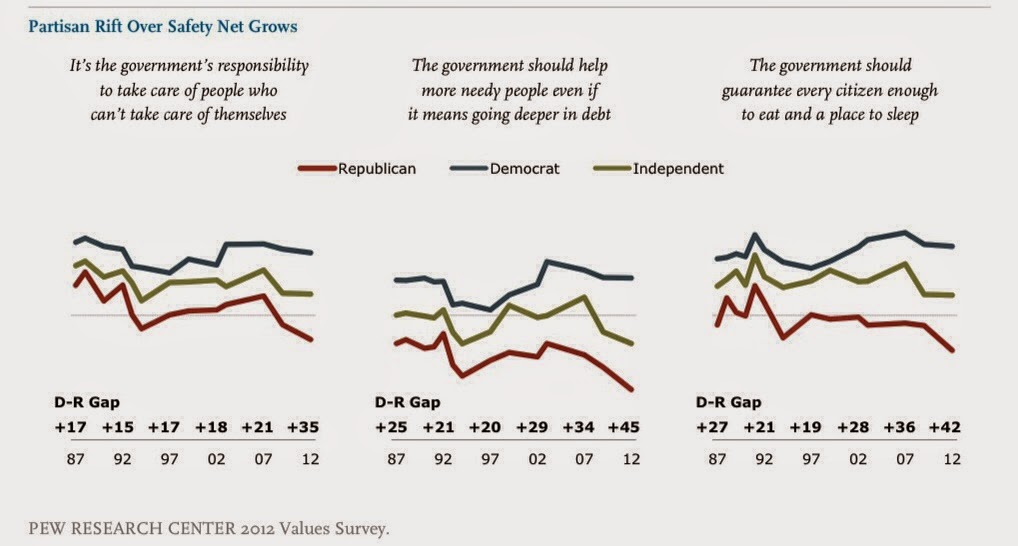
Consider, for example, how conservative messaging has created a dramatically growing partisan divide over the social safety net, identified in one graph from a 2013 Pew Research/New America Foundation report. Pew tracked agreement with three statements from 1987 through 2012, finding a widening Democratic/Republican gap in each case: “It’s the government’s responsibility to take care of people who can’t take care of themselves” (D+17 to D+35), “the government should help more needy people even if it means going deeper in debt” (D+25 to D+45), and “the government should guarantee every citizen enough to eat and a place to sleep” (D+27 to D+42). These figures reflect a massive shift in partisan GOP views over the period of time when the FCC got rid of the Fairness Doctrine, right-wing talk radio exploded across the country, and Fox News was launched by Rupert Murdoch and Roger Ailes. Questions of this sort are particularly strong indicators of ideological outlook, and they demonstrate just how successful the conservative infrastructure has been in making Republicans far more hostile to government spending helping the poor — at least on a philosophical level. This has had an enormous impact on the political discourse in the Beltway-centric media and policy circles, and progressives have suffered significantly as a result.
Yet, these sorts of ideological responses are often strikingly at odds with concrete policy positions, which tend to be much more pragmatically oriented, and thus more liberal. Indeed, over the same period of time, there were much smaller changes in attitudes when it comes to more specific spending questions asked by the General Social Survey. Looking at nine spending questions, covering items like Social Security, national education, health, assistance to the poor, to blacks and to big cities, I found that the Democrat/Republican gap changed less than 3 percent for six out of the nine — including all questions explicitly mentioning blacks, welfare or the poor. “Improving and protecting the nation’s health” was the big outlier, no doubt because Republicans in 2012 associated it with Obamacare (causing their support to plummet by 15.3 percent), which made it an apples-to-oranges comparison. Of the two remaining items, the gap widened 6.3 percent for spending on “solving problems of big cities,” but it narrowed by 8.9 percent on “improving the nation’s education system.” Thus, while the massive buildup in conservative infrastructure has produced a deep philosophical divide about America’s safety net over the past 25 years, it has had only the barest impact on attitudes about specific programs.
Given how little such basic policy attitudes have changed in 25 years, despite a massive conservative ideological onslaught, there is real reason to hope that progressive can rally support for the sort of compassionate, pragmatic vision of America as they envision it, with the sort of broad-based political organizing Payne is talking about.
Nonetheless, there are serious obstacles that such a strategy has to deal with, and I contacted Payne to ask her about them, in part because they must be dealt with in order for such a strategy to succeed — and because Payne is unusual in speaking out so openly about this need, considering the world she’s long worked in, having served as deputy national finance director for the Democratic National Committee during Clinton’s reelection campaign in 1996.
But she’s also not just spouting off thoughtlessly; organization building and citizen empowerment have long concerned her as well. She went on to be a co-founder of theDemocracy Alliance, a donor collaborative that has invested more than $100 million in progressive organizations, before founding the Agenda Project, which says its goal is “to build a powerful, intelligent, well-connected political movement capable of identifying and advancing rational, effective ideas” and “to return normal Americans to the center of the policy debate.” Clearly, if progressives are going to finally engage in a systemic response to 50 years of conservative infrastructure building, she’s just the sort of person to help bring that about. The answers she offered don’t really solve the problems these obstacles represent; they aren’t intended to. But they do get us engaged in the process of finding solutions — a process that’s been delayed for far too long.
I began by asking about a major problem facing progressives trying to counter conservative political infrastructure — the basic political power imbalance, shown by recent research — by Martin Gilens, most notably — which favors the wealthy over average Americans. While there’s more to right/left than just economics, there’s little doubt that economics are a crucial driving force. For most of the past 50 years, Thomas Frank’s formulation from ”What’s the Matter With Kansas” has held true:
Vote to stop abortion; receive a rollback in capital gains taxes. Vote to make our country strong again; receive deindustrialization. Vote to screw those politically correct college professors; receive electricity deregulation. Vote to get government off our backs; receive conglomeration and monopoly everywhere from media to meatpacking….
Because economics has been so central, the evidence uncovered by Martin Gilens is particularly troubling for any effort to build power on the left. His 2013 book, ”Affluence and Influence: Economic Inequality and Political Power in America,” considered thousands of proposed policy changes, and the degree of support for each among poor, middle-class and affluent Americans. Summarizing his results, Gilens wrote, “The American government does respond to the public’s preferences, but that responsiveness is strongly tilted toward the most affluent citizens. Indeed, under most circumstances, the preferences of the vast majority of Americans appear to have essentially no impact on which policies the government does or doesn’t adopt.”
This year, Gilens followed up with a paper co-authored by Benjamin Page, “Testing Theories of American Politics: Elites, Interest Groups, and Average Citizens.” In that paper, they analyzed a data set covering 1,779 policy issues, and found that “economic elites and organized groups representing business interests have substantial independent impacts on U.S. government policy, while average citizens and mass-based interest groups have little or no independent influence.”
So how does Payne see a left infrastructure-building project dealing with this heavily tilted playing field?
“As research and common sense have shown, there can be no doubt in any rational person’s mind that the agenda of wealthy Americans takes precedence over that of regular citizens,” she readily agreed, going on to say:
Recent case in point, the overwhelming – and bipartisan — support for increasing the minimum wage and the failure of the Senate (due to Republican opposition) to even bring the issue up for debate. But it isn’t just the fault of conservative politicians and their donors, the blame also lies with Democrats. President Obama just a year ago called for a $9 federal minimum wage – it was only under intense pressure that he raised the proposal to $10.10.
This is a crucial point: Don’t discount the impact we can have on our own side. But Payne had more to say about the long view of history:
To give in to feelings of hopelessness in the face of “unequal representation” in our (so-called) representative democracy would be to misunderstand the arc of history and to grossly underestimate the power of regular people to make profound societal change. The obvious examples are the civil rights movement and the women’s movement. It has been done in the past and it will be done again in the future. The question – both for the wealthy and for un-wealthy – is this: What side of history will you be on? And what will you have done to realize both the American experiment, but also more interestingly the human experiment.
Along these lines, it’s worth remembering that when the abolitionists started out, Northern elites were as committed to slavery as Southerners were. Before that, you had slave revolts, led by the likes of Gabriel Prosser and Denmark Vesey, the most extreme example of the economically powerless nonetheless organizing to change the course of history.
Even on a shorter time frame, Gilens himself wrote that “there are exceptions to this pattern, and conditions that are more conducive to the representation of the middle class and low-income people.” Which means the odds are stacked against us — which we already knew — but that we still have chances to win.
Next, I asked Payne about the internalization of right-wing ideas on the left, and gave the example of Obama’s endorsing the notion that the government had to tighten its belt in a recession. “I don’t agree with the frame of this question,” Payne began, saying:
The stimulus of 2009 was big – it just wasn’t big enough to do the job. So it was less that President Obama wanted to tighten the belt in the recession and more that he wasn’t willing to loosen it enough to jump-start the economy. This could be an internalization of right-wing ideas on the left, or more likely it could be a misunderstanding of the “possible.” To quote Daniel Burnham: “make no little plans, they have no magic to stir men’s blood … Make big plans, aim high in hope and work.”
Broadly speaking, it is less that Democrats (and I’m consciously leaving out Wall Street Democrats in this analysis) have internalized right-wing ideas and more that they have lost their courage – if they had it in the first place. President Obama has not demonstrated political courage during his presidency. From Wall Street reform to tax policy he has played it safe.
I think that Payne is certainly onto something here. But the diminished sense of the “possible” she refers to is strikingly at odds with the campaign that candidate Obama ran — and this in turn feeds the notion that he’s internalized some ideas that clash significantly with how he campaigned, and built the support that made him president in the first place. It may be more than just playing it safe; it may be a misguided notion of what counts as reasonable, something he’s not alone in, by any means.
tPayne went on to argue that there was far more internalization of right-wing views during Clinton’s presidency:
No one I know on the left – with the exception possibly of the foreign policy community – has internalized anything the right believes. This is why I see change on the horizon. During Clinton’s presidency, there was substantially more of that internalization. In many ways, President Clinton was the best Republican president since Ronald Reagan – his three signature accomplishments were NAFTA, welfare reform and dismantling the rules that governed Wall Street. In his defense, he didn’t know at the time how they would turn out. Today’s Democrats don’t have that excuse. They know exactly how all three of these ideas turned out.
But given the failure to restore Glass-Steagall, for example, I’m not really sure how well those lessons have been learned. More important, even 20/20 hindsight tells us nothing about foresight.
This led directly to my next concern, the continued dominance of right-wing intellectual frameworks — such as neoliberalism or law and economics — despite well-articulated, but widely neglected critiques. Payne’s response was encouraging, but only a start, I feared:
Again, I think this is changing – and where it isn’t changing, I think there is a greater understanding on the part of progressive funders that it needs to change. Look at Soros’ investment in INET [the Institute for New Economic Thinking]. What is important here is to attack university presidents who sell out their intellectual credibility to the highest bidder. Look at the Olin Center at Harvard and the Hoover Institute at Stanford : Both centers paid for the imprimatur of these prestigious universities; housing these centers at these universities was deliberate.
I agree with everything Payne said here, although the battle against neoliberalism has only fitfully been joined, due to some fundamental misunderstandings, as Philip Mirowski has argued. But even more underappreciated is a very specific, powerful critique of law and economics, from Harvard Law professor Jon Hanson, and various collaborators, which shifts the focus from an unrealistic, theoretical model of individual choice to a realistic account of human action embedded in complex social and cultural settings, based on findings from a broad range of mind sciences. Law and economics is grounded in the soil of neoclassical economics, with its rational actors and other empirically questionable assumptions, but then exports such thinking into the legal realm, and thus into far-flung policy realms as well. In the name of exulting the individual, it actually flacks for the hidden power of the largest corporate actors.
Hanson’s approach, described as “critical realism” or “situationism,” deftly dispels the illusions involved — but unfortunately remains far too little known in wider policy circles. (For a broad, informal introduction, see this Harvard Law School interview.) The awareness of implicit racial bias, which spread rapidly in the wake of the Trayvon Martin shooting, is just one example of the powerful kinds of mind science findings that situationism incorporates into a rich tapestry of understanding — a tapestry that’s essential to accurately describing our social world in all of its complexity, so that we might better navigate it individually, and reshape it collectively so that it better serves us all. We desperately need a much wider awareness of situationist tools if we are to successfully reshape the world.
Next, I asked Payne about unrecognized sources of internal incoherence and conflict within the progressive community as a whole, in part related to the previous two issues I raised. I cited the example of Anat Shenker-Osorio’s work on the problems progressives have in communicating about economics, in her book “Don’t Buy It: The Trouble With Talking Nonsense About the Economy” and elsewhere.
“I think Anat’s work is brilliant and cutting edge,” Payne responded. “It will take time for those ideas to take root, but they will get there. We are on a long trajectory.” Perhaps the same could be said about Hanson’s.
Expanding on her last point, Payne elaborated:
It was just 12 years ago that people woke up to what the right wing had built since the 1964 Goldwater defeat. I was in many of those early meetings in which we shared the research about the right-wing intellectual and communications infrastructure with activists, funders and political leaders. The idea that there was a world outside – or, more accurately, underneath and behind — electoral politics was paradigm shifting. Now, 12+ years later working together, those people have built some of the institutions that will change the country for the better. But as trite as it sounds, you have to walk before you run – and these organizations have just now begun to get to the place where they can start to run.
If this progress sounds distressingly slow to you, well, isn’t that an argument for Payne’s proposition that building this capacity is the most sensible form that Obama’s legacy should take?
One final obstacle I asked about was the functional imbalance between progressives and conservatives that flows from being more interested in making government work, and thus put a lot of time and effort into service providing, research and the like, as opposed to constant political warfare, which is the only thing that many on the right seem to care about.
“Progressives are learning how to fight – it’s slow but they are learning,” Payne said. “Democratic politicians will learn too. If they can fight with moral certainly they will win.”
I’d like to end with something else Payne said about one of her core concerns: courage.
The question they [today's Democrats] have to answer now is, “Are they brave enough to change?” And understand the word “brave” – and its sister word “courage”: Courage is not the absence of fear, it is the understanding that there is something that is more important than fear. What political leaders must assess is whether they think our country – and its citizens – are more important than their next reelection. And as long as they continue to think their next reelection is more important than the country, we will continue to underperform our potential as a nation. In the same way that companies who focus on short-term returns ultimately underperform.
What better long-term legacy could Obama want than to encourage others to take the long view as well?
|
|
|
FOCUS | Bernie Sanders Is Beating the Austerity Hawks |
|
|
Saturday, 14 June 2014 13:00 |
|
Nichols writes: "Bernie Sanders does not believe that government always gets things right. But the independent senator from Vermont does believe that where government has the capacity to act on behalf of those in need, it should do so."

Senator Bernie Sanders of Vermont. (photo: Rich Pedroncelli/AP)
Bernie Sanders Is Beating the Austerity Hawks
By John Nichols, The Nation
14 June 14
 ernie Sanders does not believe that government always gets things right. ernie Sanders does not believe that government always gets things right.
But the independent senator from Vermont does believe that where government has the capacity to act on behalf of those in need, it should do so.
In a capital where an awful lot of folks still buy into Ronald Reagan’s “government is the problem” calculus, Sanders knows that government can be the solution. Indeed, he recognizes that for those most neglected by an economy that almost always takes care of CEOs and celebrities but often fails clerks and construction workers, government is able to provide answers that the private sector cannot or will not produce.
“In the US Senate today, my right-wing colleagues talk a lot about “freedom” and limiting the size of government,” says Sanders. “Here’s what they really mean: They want ordinary Americans to have the freedom not to have health care in a country where 45,000 of our people who die each year because they don’t get to a doctor when they should. They want young people in our country to have the freedom not to go to college, and join the 400,000 young Americans unable to afford a higher education and the millions struggling with huge college debts. They want children and seniors in our country to have the freedom not to have enough food to eat, and join the many millions who are already hungry. And on and on it goes!”
Sanders cannot always get the Senate to consider the alternative. But as the chairman of the Senate Veterans Affairs Committee, he has the authority and the bully pulpit to focus the nation’s attention not just on the neglect of military veterans—an issue that has long been his focus—but on the solutions government can provide for them.
Even before the details of how veterans are forced to endure excessively long wait times to access VA medical care were revealed, Sanders had written and advanced major legislation to address the underfunding of VA services and a host of other programs for veterans.
Unfortunately, though the measure Sanders proposed was backed by every major veterans group, it was blocked last February by Senate Republicans.
Then came the revelations of the extent of the dysfunction at VA hospitals—most recently in the form of a Veterans Affairs Department audit describing how more than 57,000 veterans have been forced to wait at least three months for their first appointments. And that another 64,000 veterans who asked for appointments over the past ten years never got the attention they requested—and deserved.
Sanders saw an opening to talk about what could, and should, be done. He started looking for allies. He found one in Senator John McCain, the Arizona Republican and Vietnam War POW.
Together, Sanders and McCain crafted a response to the crisis. Yes, there were compromises. But the outlines of what Sanders had previously proposed were very much in evidence in the proposal to spend $35 billion over three years to dramatically improve VA staffing and to provide resources for vets seeking care from doctors close to home.
Sander told the Senate, “The cost of war does not end when the last shots are fired and the last missiles are launched. The cost of war continues until the last veteran receives the care and the benefits that he or she is entitled to and has earned on the battlefield.”
This time, the Senate agreed.
The often bitterly divided chamber voted 93-3 in favor of the Sanders-McCain plan.
When conservative Republicans objected to the price tag, McCain told them, “Make no mistake: this is an emergency.”
The most austerity-obsessed Republicans—Senators Bob Corker of Tennessee, Jeff Sessions of Alabama and Ron Johnson of Wisconsin—still voted “no.”
But most of Senate Republicans, including some of the chamber’s most conservative members, voted “yes,”
In so doing, they recognized the need for an ambitious expansion of government service, and of government aid to those who are most in need.
How ambitious?
The Sanders-crafted measure the Senate backed seeks to
- Authorize leases for twenty-six new medical facilities in seventeen states and Puerto Rico.
- Designate funds for hiring more VA doctors and nurses to provide quality care in a timely manner.
- Expand existing VA authority to refer veterans for private care. Veterans experiencing long delays at the VA could seek care instead at community health centers, Indian health centers, Department of Defense medical facilities or private doctors. The two-year program also would offer those same options to veterans who live more than forty miles from a VA hospital or clinic.
The measure also expands accountability, giving the VA the authority to remove or demote administrators who have failed to meet the needs of vets, while creating incentives for reducing wait times at VA facilities. It also recognizes that healthcare is not the only need vets have; so the measure includes language to assure that “all recently-separated veterans taking advantage of the Post 9/11 GI Bill get in-state tuition at public colleges and universities.”
And, notes Sanders’s office, “for the first time, those same education benefits would be extended to surviving spouses of veterans who died in the line of duty.”
This is a big response to a big problem.
It still faces hurdles. The austerity hawks who are so good at thinking up reasons to go to war but so bad at paying for them—and so very bad at meeting commitments to those who serve—will keep raising objections. House Republicans are making predictable demands for “offsets” equaling the cost of the VA initiative, peddling the fantasy that other programs must be cut in order to find the money to aid veterans. The Philadelphia Inquireris hails the Senate measure as “an unusually swift and welcome response” that has “broad support and the potential to alleviate some of the department’s serious shortcomings.”
The prospect that a major problem will be met with a major response is real—as is the recognition that Senator Sanders has been right all along: sometimes government has to be part of the solution.
|
|
FOCUS | The Subsidiary of Koch Industries Formerly Known as Wisconsin |
|
|
Written by <a href="index.php?option=com_comprofiler&task=userProfile&user=11104"><span class="small">Charles Pierce, Esquire</span></a>
|
|
Saturday, 14 June 2014 11:35 |
|
Pierce writes: "Things are livening up in the subsidiary of Koch Industries formerly known as the state of Wisconsin. Recently, a federal judge threw out the state law banning marriage equality. Some county clerks, bless 'em, started handing out marriage licenses to same-sex couples. Not so fast, said Attorney General J.B. Van Hollen, an ally of Scott Walker."

Wisconsin Gov. Scott Walker. (photo: Madison Times)
The Subsidiary of Koch Industries Formerly Known as Wisconsin
By Charles Pierce, Esquire
14 June 14
 hings are livening up in the subsidiary of Koch Industries formerly known as the state of Wisconsin. Recently, a federal judge threw out the state law banning marriage equality. Some county clerks, bless 'em, started handing out marriage licenses to same-sex couples. Not so fast, said Attorney General J.B. Van Hollen, an ally of Scott Walker, the goggle-eyed homunculus hired by Koch Industries to manage this particular subsidiary. Not only is he telling the clerks to cease and desist in their complicity with equality, but he's also threatening to throw them in the sneezer if they don't continue to practice the previously established public bigotry. OK, I'm paraphrasing a little. hings are livening up in the subsidiary of Koch Industries formerly known as the state of Wisconsin. Recently, a federal judge threw out the state law banning marriage equality. Some county clerks, bless 'em, started handing out marriage licenses to same-sex couples. Not so fast, said Attorney General J.B. Van Hollen, an ally of Scott Walker, the goggle-eyed homunculus hired by Koch Industries to manage this particular subsidiary. Not only is he telling the clerks to cease and desist in their complicity with equality, but he's also threatening to throw them in the sneezer if they don't continue to practice the previously established public bigotry. OK, I'm paraphrasing a little.
Van Hollen, a Republican, told the Milwaukee Journal Sentinel newspaper that gay couples who have married since U.S. District Judge Barbara Crabb issued her ruling last week aren't legally married and district attorneys could opt to charge county clerks who issued them licenses with a crime. "That's going to be up to district attorneys, not me," Van Hollen said. "There are penalties within our marriage code, within our statutes, and hopefully they're acting with full awareness of what's contained therein. ... You do have many people in Wisconsin basically taking the law into their own hands, and there can be legal repercussions for that."
Abiding by the decision of a federal judge is now "taking the law into your own hands"? This is new legal territory here.
Dane County, the most liberal county in the state, began issuing licenses within hours of Crabb's June 6 decision. Clerk Scott McDonell called Van Hollen's warning that prosecutors could charge clerks "ridiculous." "There has to be (criminal) intent. If a reasonable person can read that the judge clearly invalidated the state ban on same-sex marriage, what would be the charge?" he said.
Uh, perhaps First Degree Inconveniencing Our Lightweight Governor's Plans To Run For President? The evidence for the prosecution? Scott Walker is squirting out a big old cloud of ink.
In 2010, he campaigned for governor as a supporter of traditional marriage. He also opposed a law that allowed gay couples to register with counties to get certain benefits, such as hospital visitation rights. "My position has been clear," Walker said Thursday. Indeed, it was. But that is no longer the case. During a 12-minute news conference at a muddy and messy groundbreaking event in Oak Creek, the first-term Republican governor argued that his position on same-sex marriage is no longer relevant. "It really doesn't matter what I think now," Walker said at one point. "It's in the constitution." And it's out of his hands, he suggested. U.S. District Court Judge Barbara Crabb has overturned the state's constitutional amendment, but Attorney General J.B. Van Hollen is appealing that decision. Van Hollen is also raising the possibility of prosecutors charging county clerks who permit gay marriages. "If the people voted to change something in the state's constitution, I think it is right for the state's attorney general to uphold the constitution," Walker said, without explicitly stating whether he agreed with the idea of prosecuting county clerks.
My Lord, our friend Doyle Lonegan is getting a real workout today.
|
|



 o after the grotesquerie of the Taliban and Osama bin Laden and 15 of the 19 suicide killers of 9/11, meet Saudi Arabia’s latest monstrous contribution to world history: the Islamist Sunni caliphate of Iraq and the Levant, conquerors of Mosul and Tikrit – and Raqqa in Syria – and possibly Baghdad, and the ultimate humiliators of Bush and Obama.